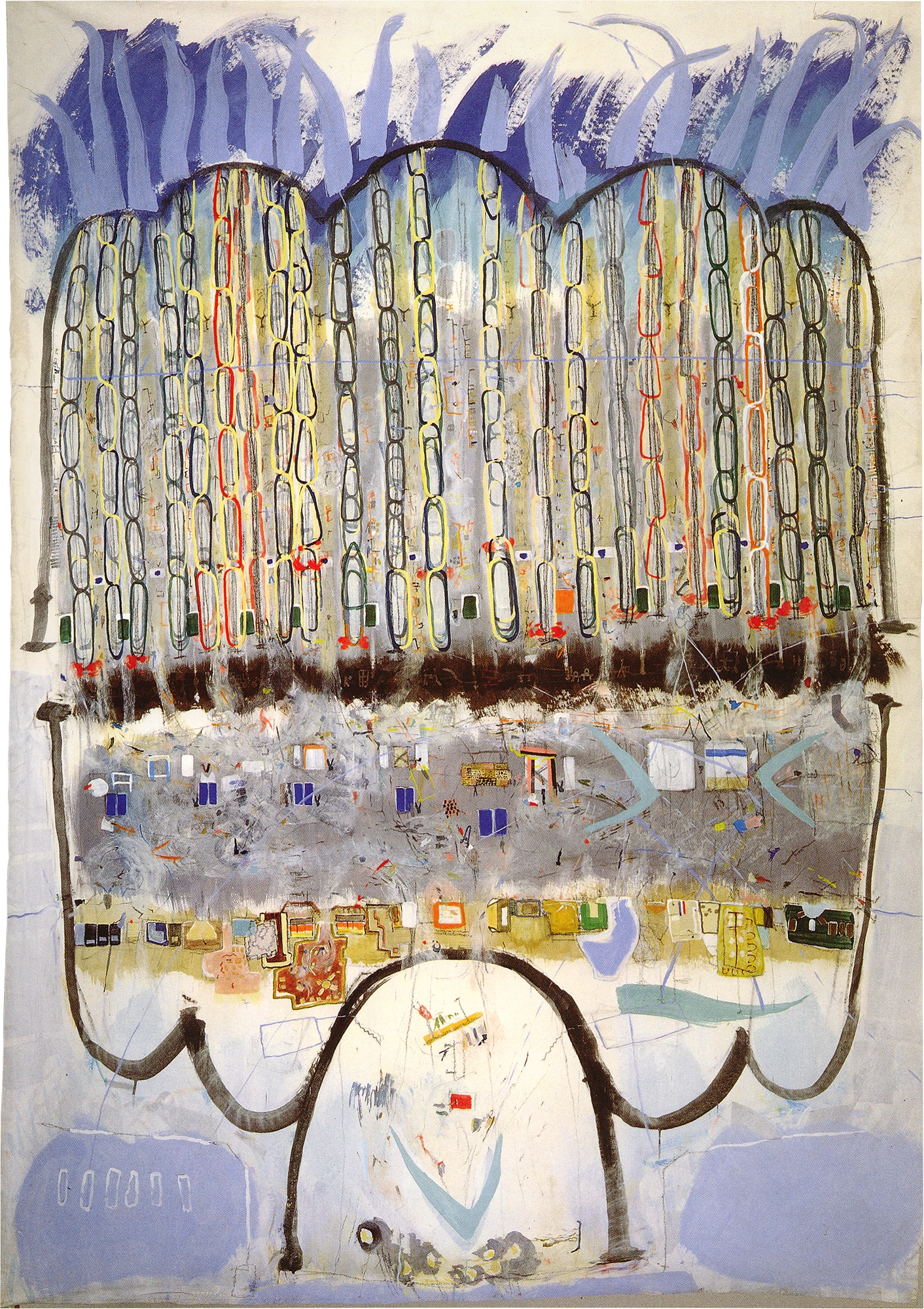
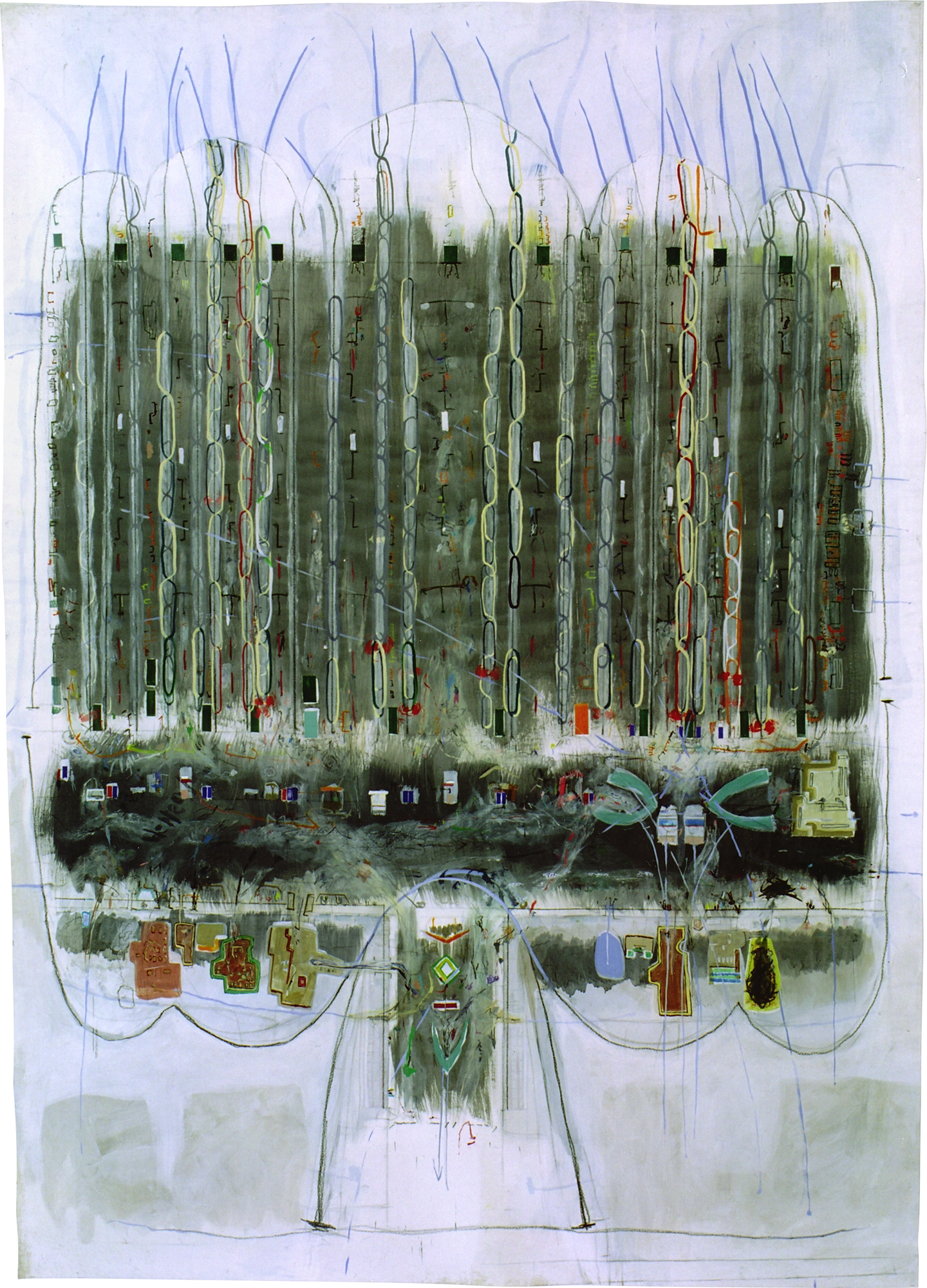
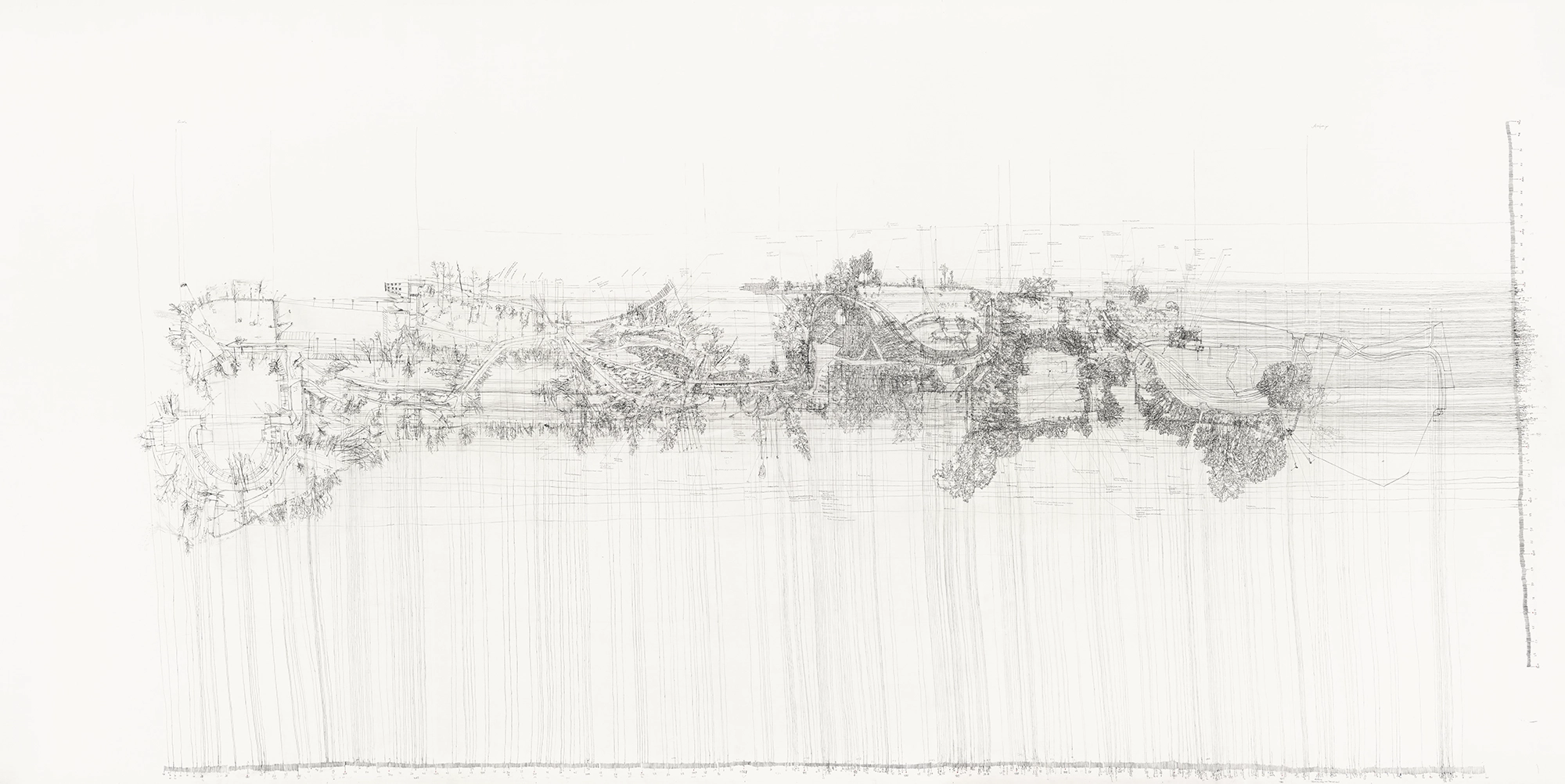
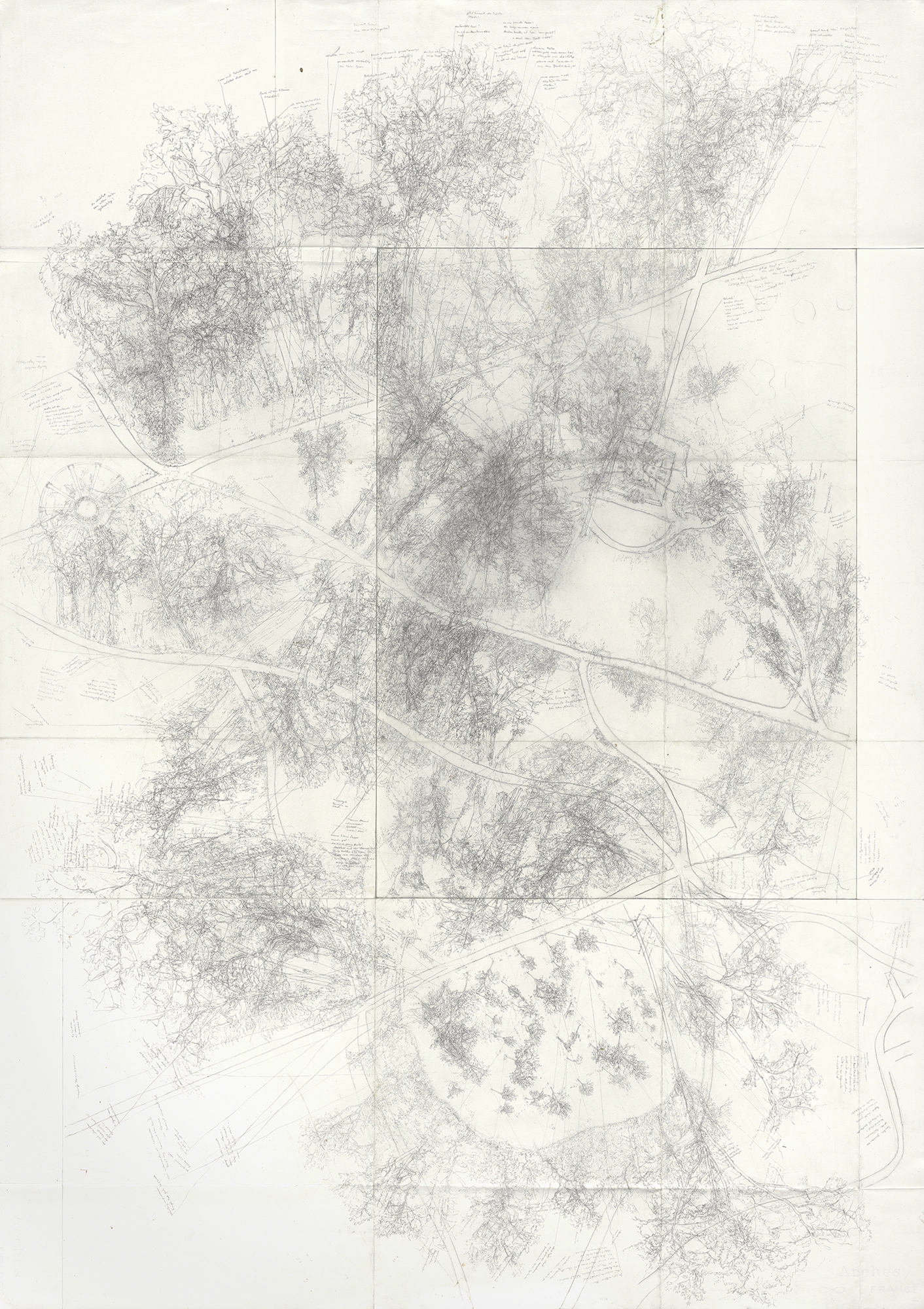
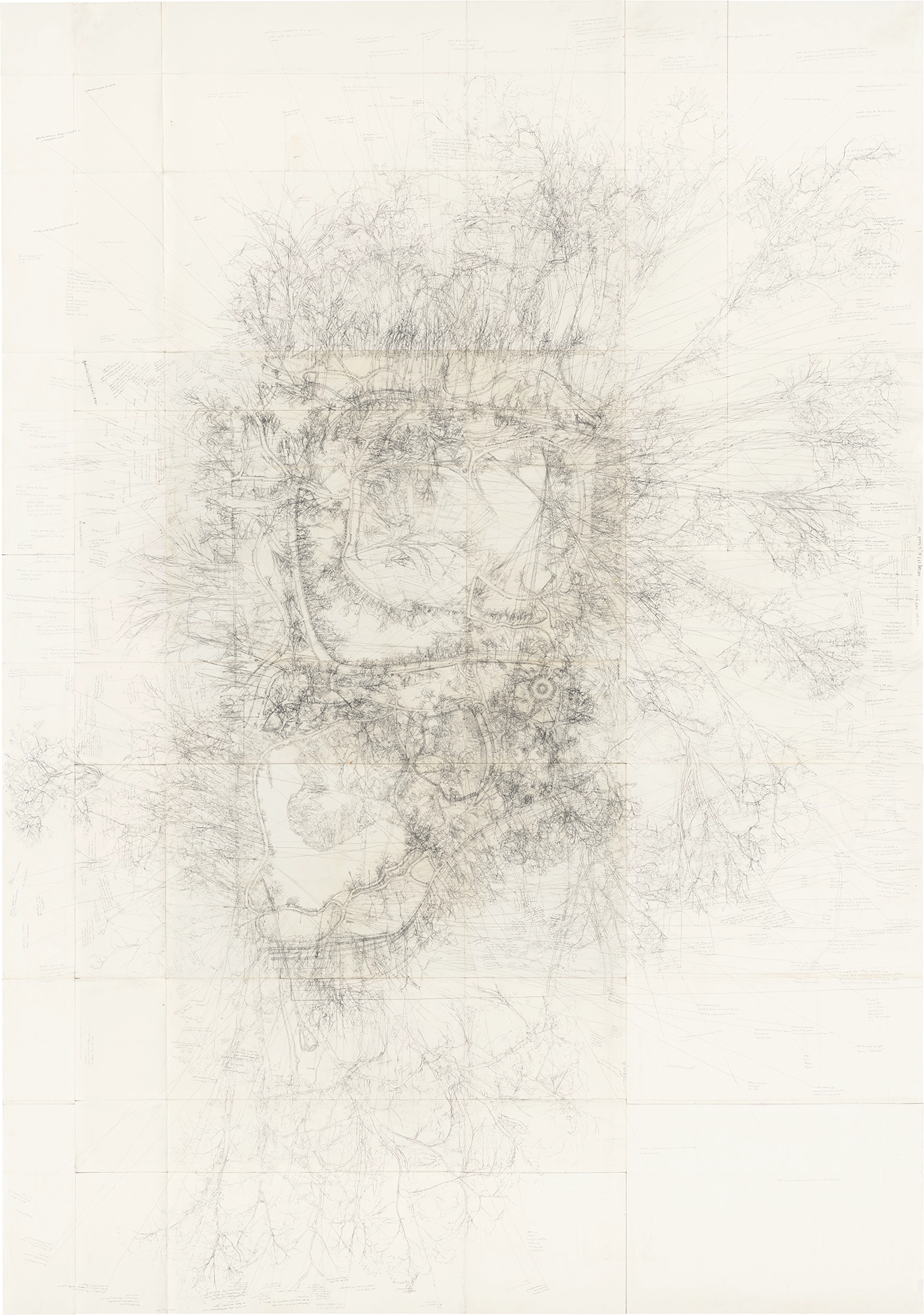
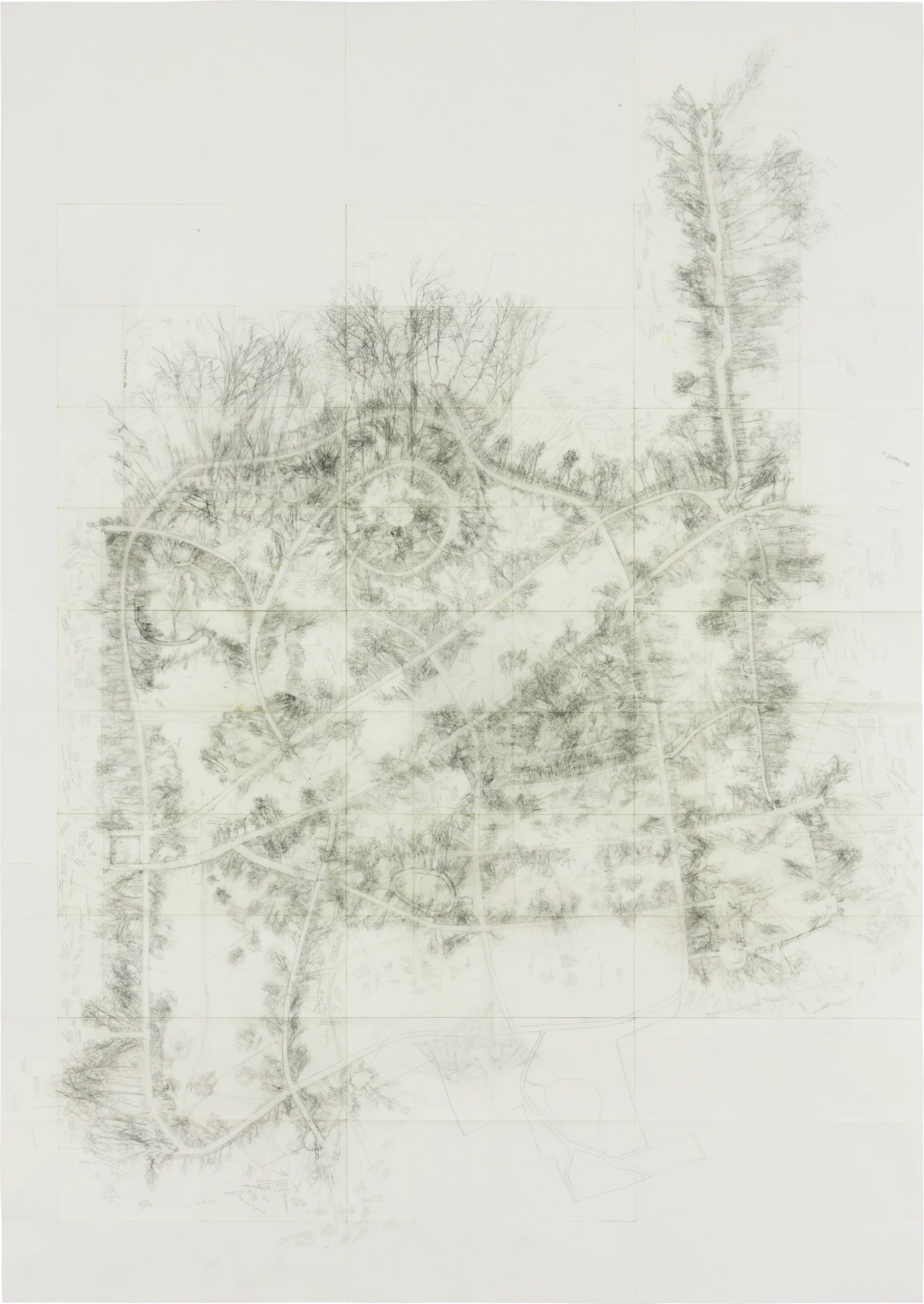
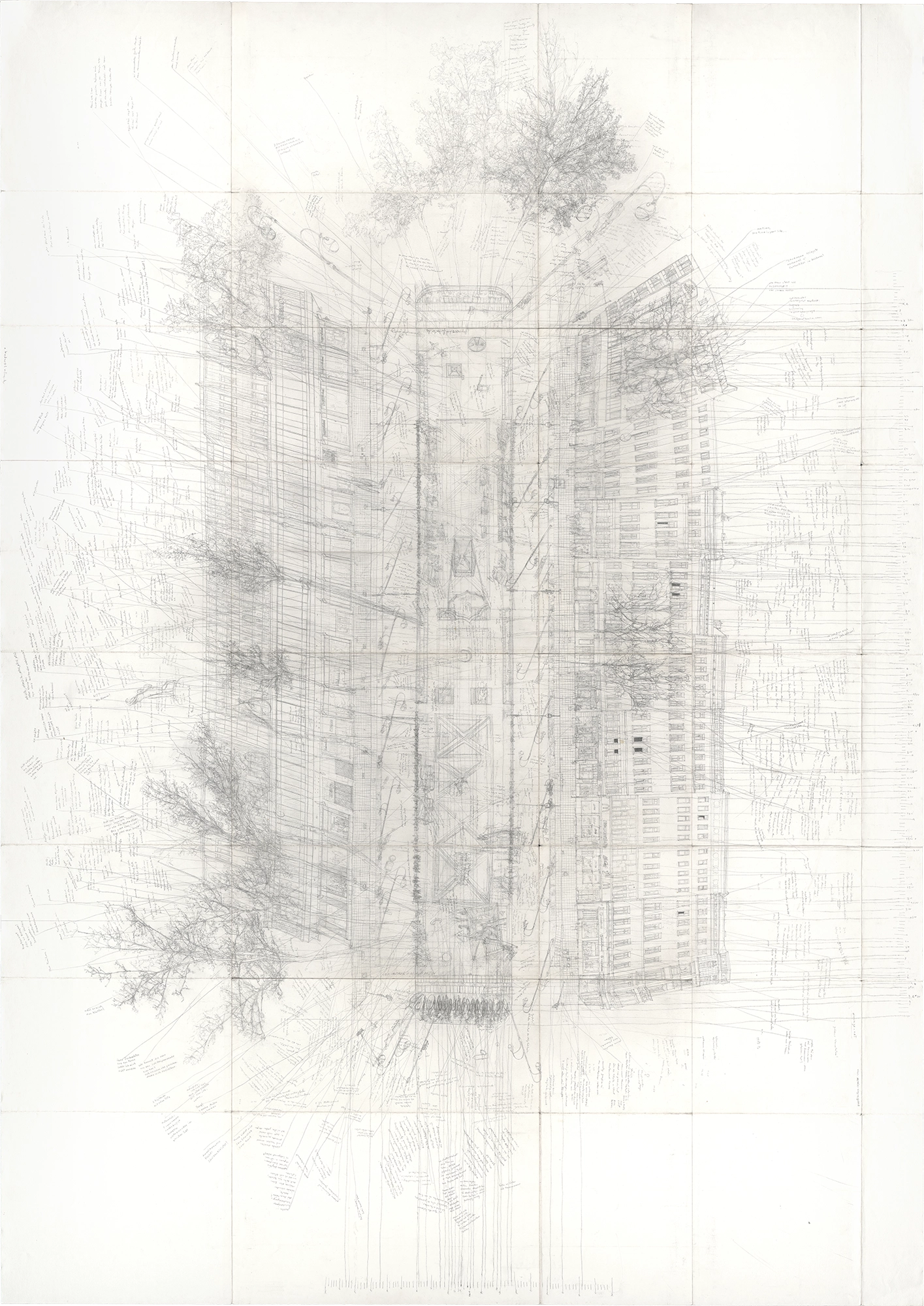
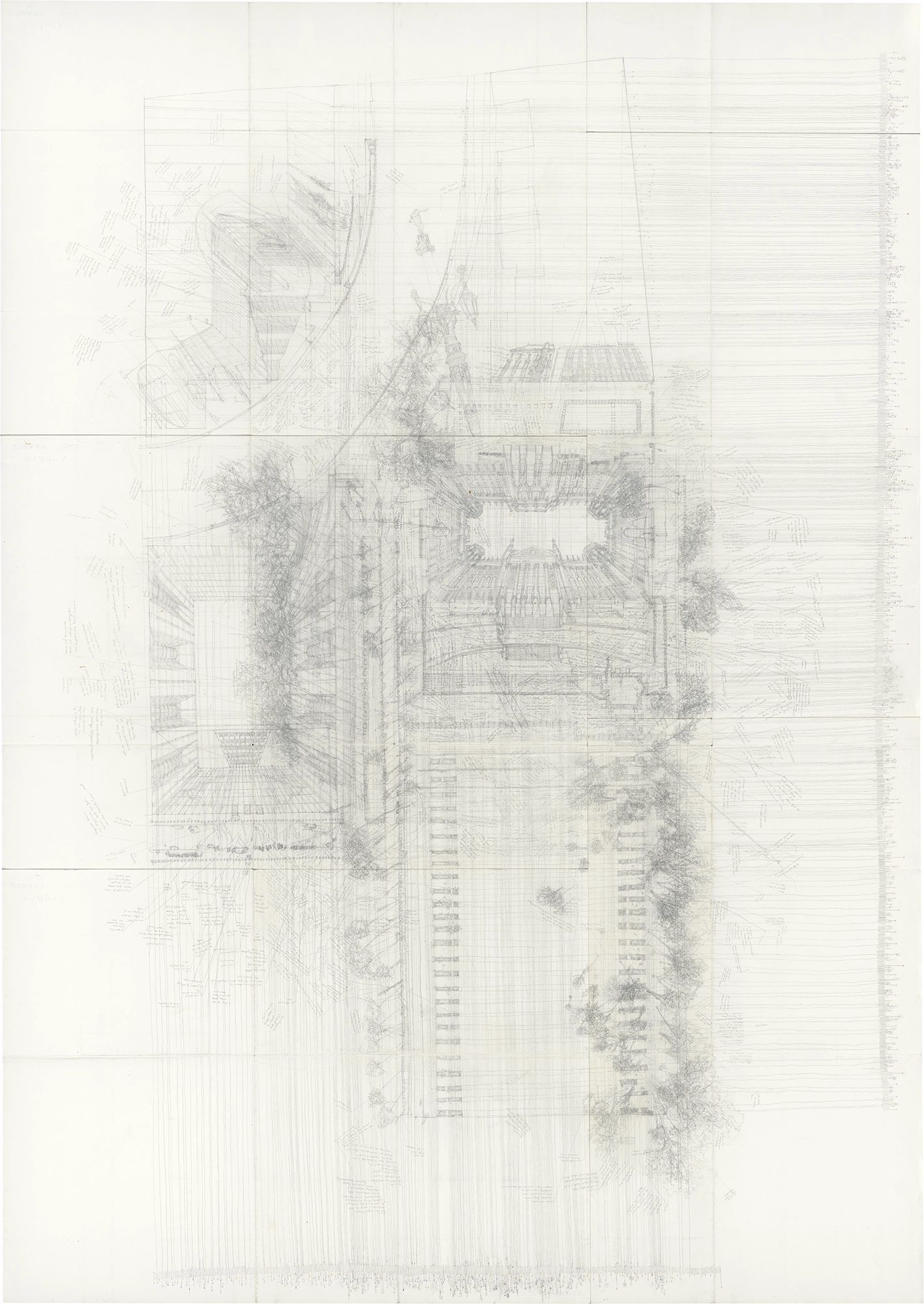
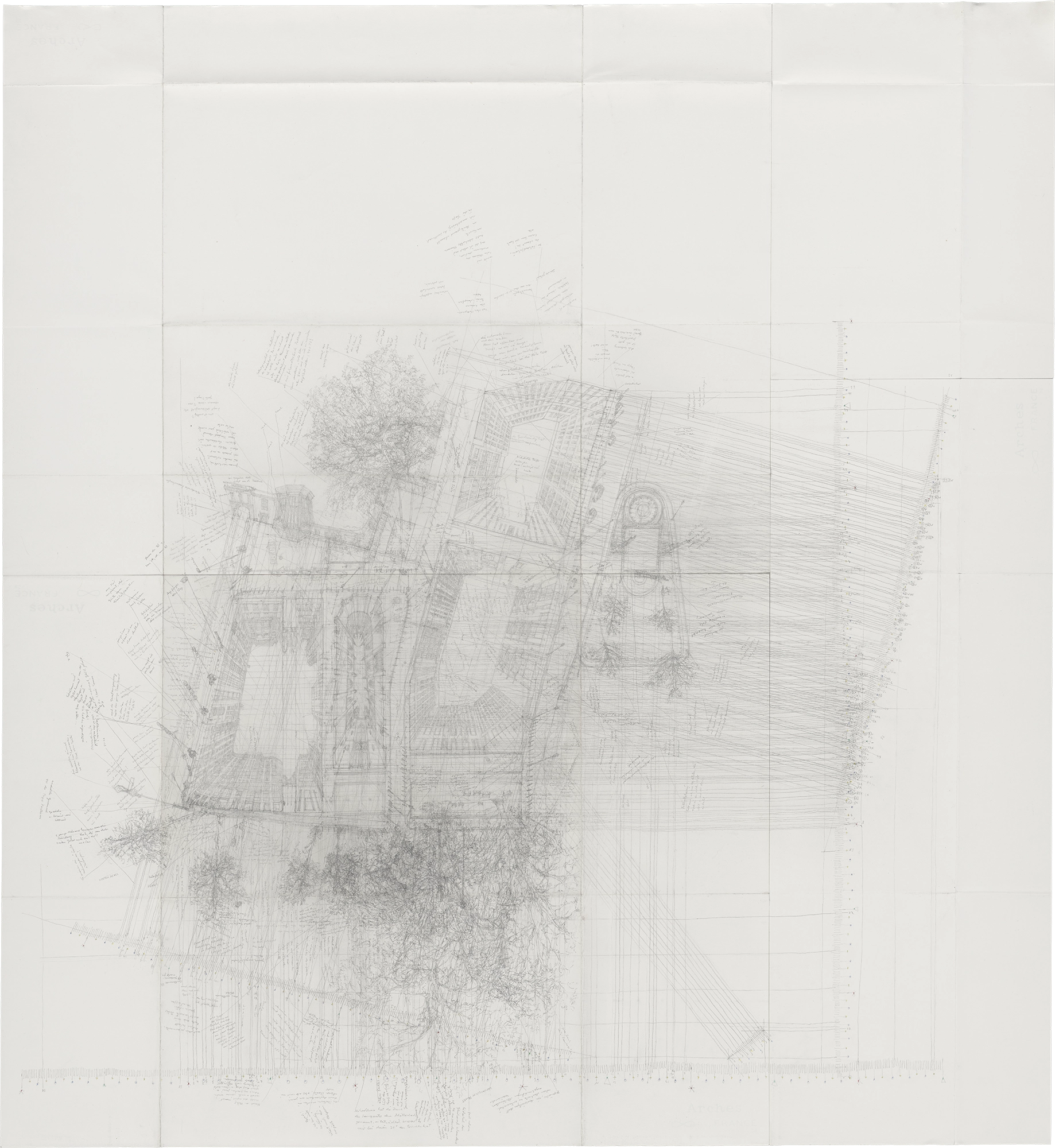
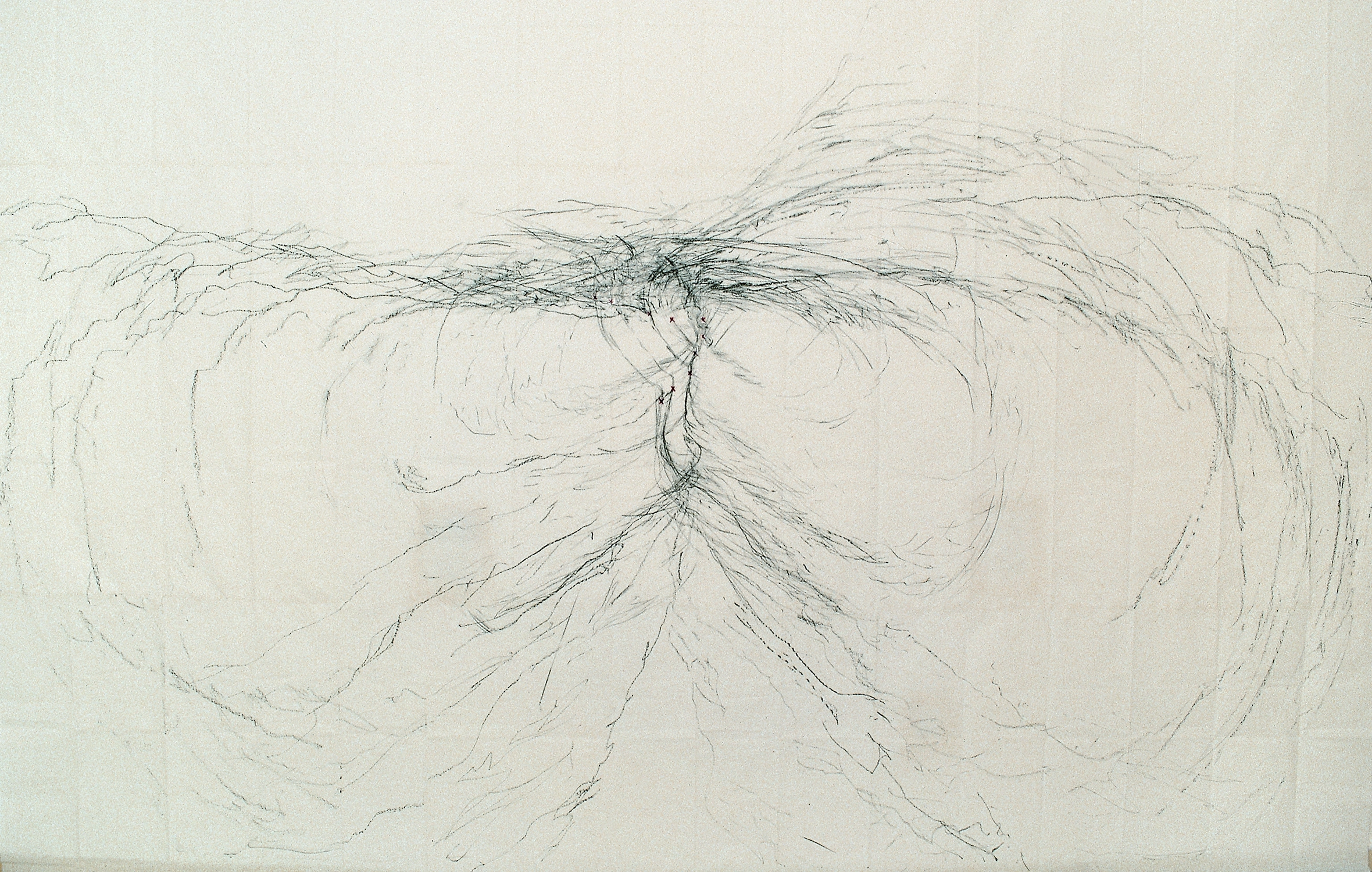
During a one-year working scholarship in London in 2005/06, I revisited the cartographic-style Early Site Specific Pictures of the 1980s in a modified form. There I worked for many months on the large-scale drawing of the extensive Mile End Park. + read more
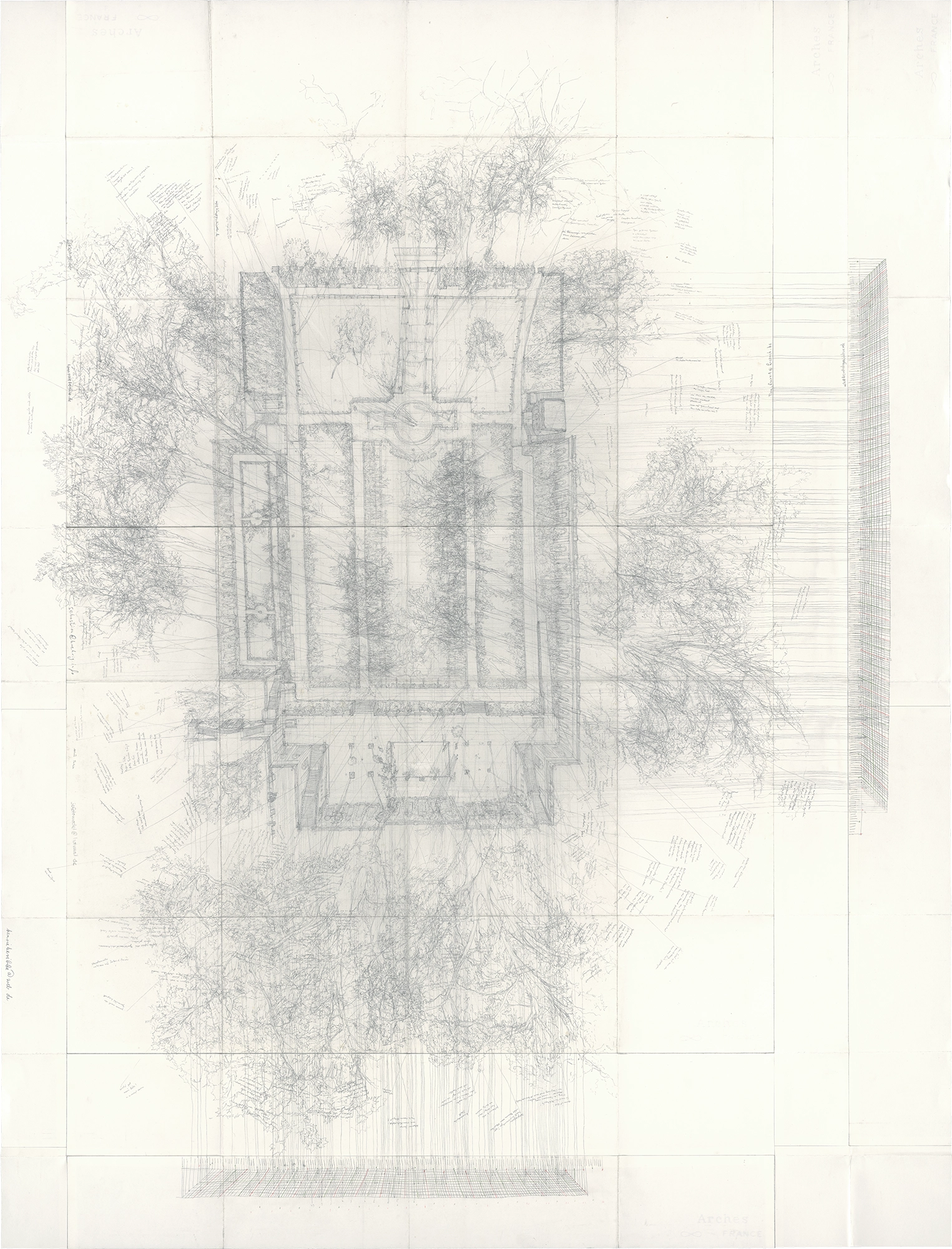
First, I measure the whole territory with footsteps and work out on large-scale paper with the aid of a developed step count scale an exact plan. On transportable fragments of the plan, I note my observations with precision directly on the spot. Thereby I am sucked into the undertow of miniaturizing. Lastly, I transfer the detail studies into the unity of the large-scale drawing, which contains the step count scale. While the countless pedestrian perspectives melt into a kind of birds-eye-view, the park landscape is transformed into a floating monad, which is still connected to the step count scale only by fine lines.
With the approach I combine 2 perspective concepts that complement and exclude each other at the same time. Their incompatibility frees up creative space that allows me to proceed according to my own choreography. The drawing as a whole takes on a form of its own. Something third emerges from the detailed exploration of the location.
To this day, I have continued the group of the Site Related Drawing Projects, repeatedly modifying the approach.
− read less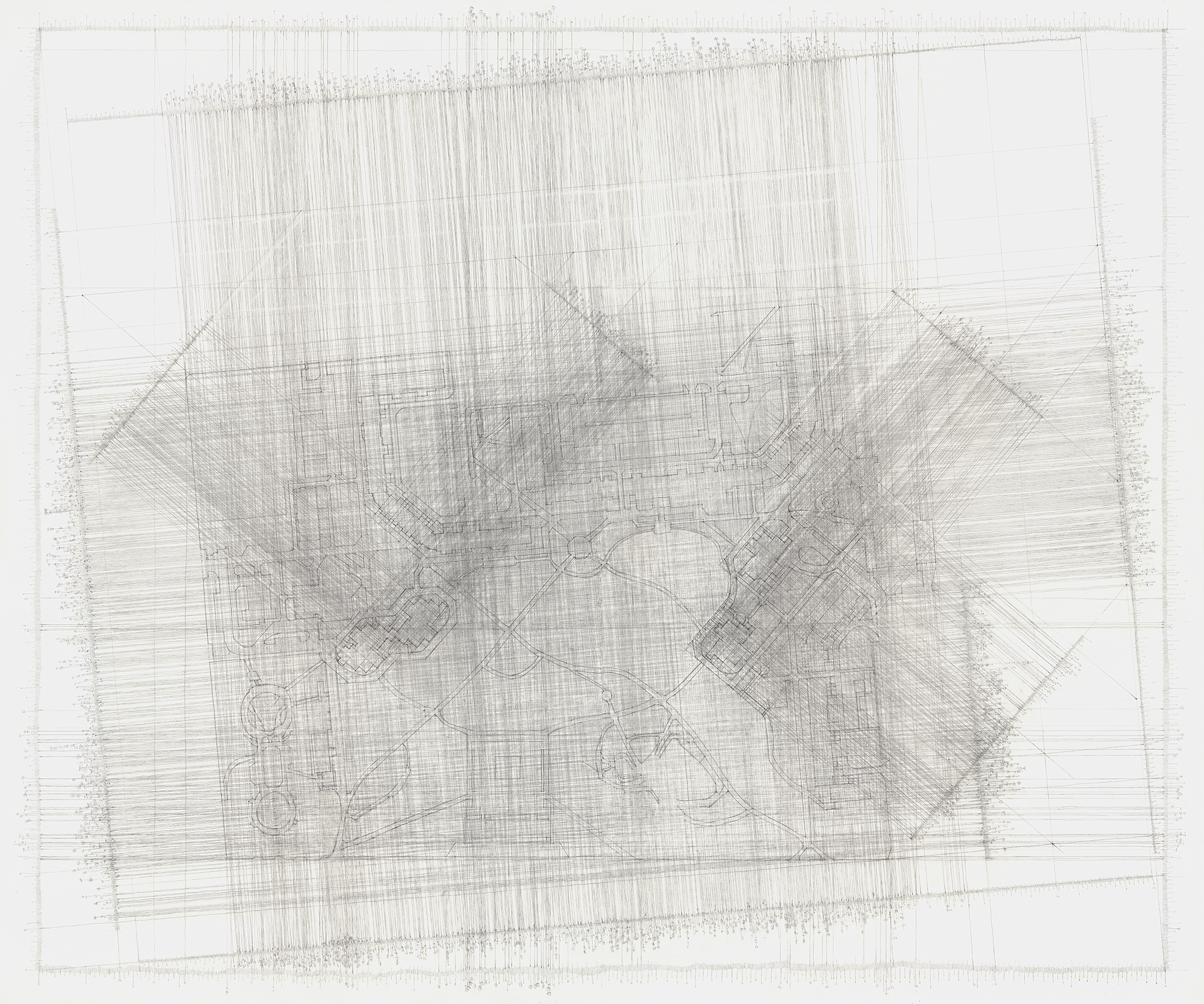
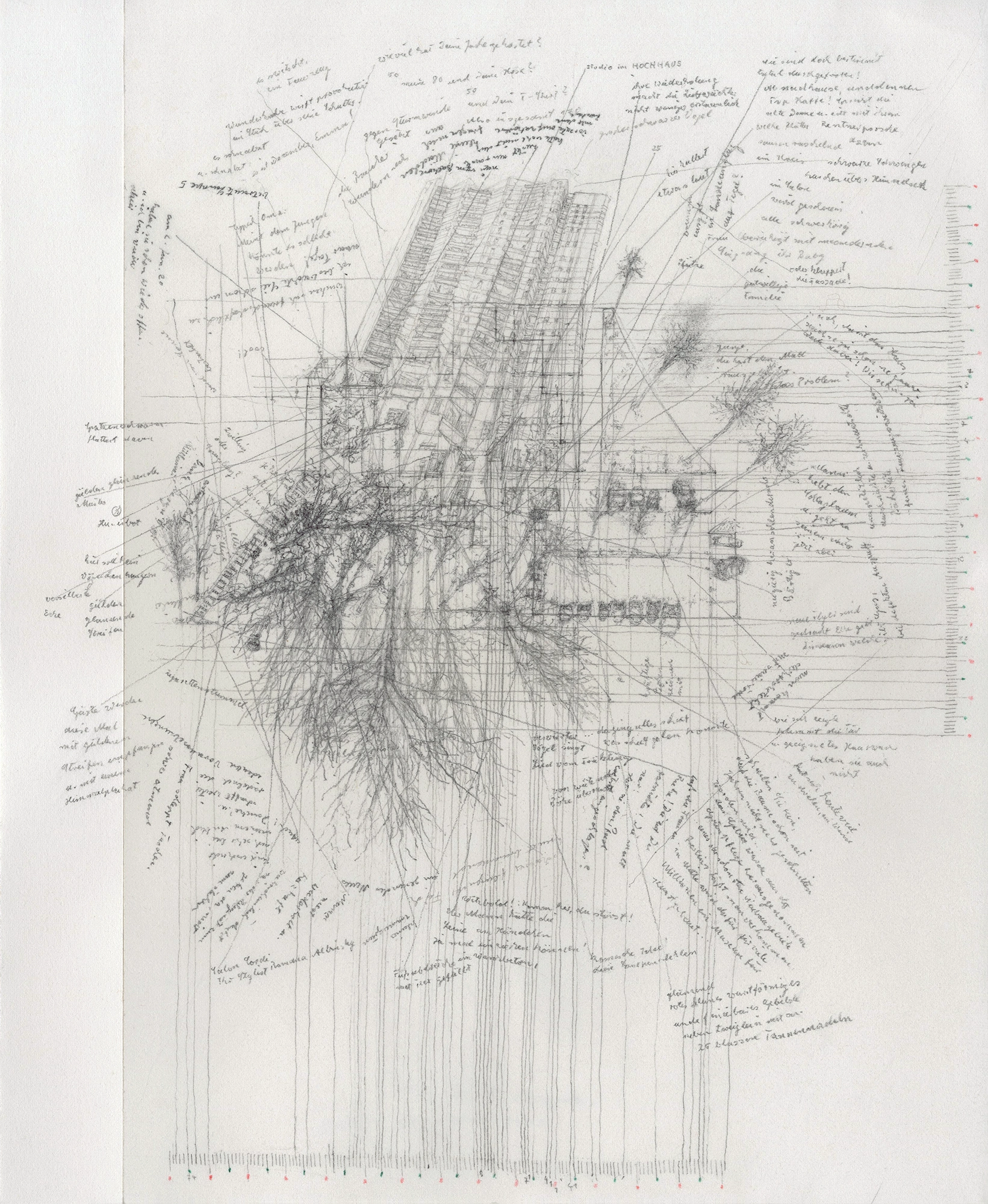
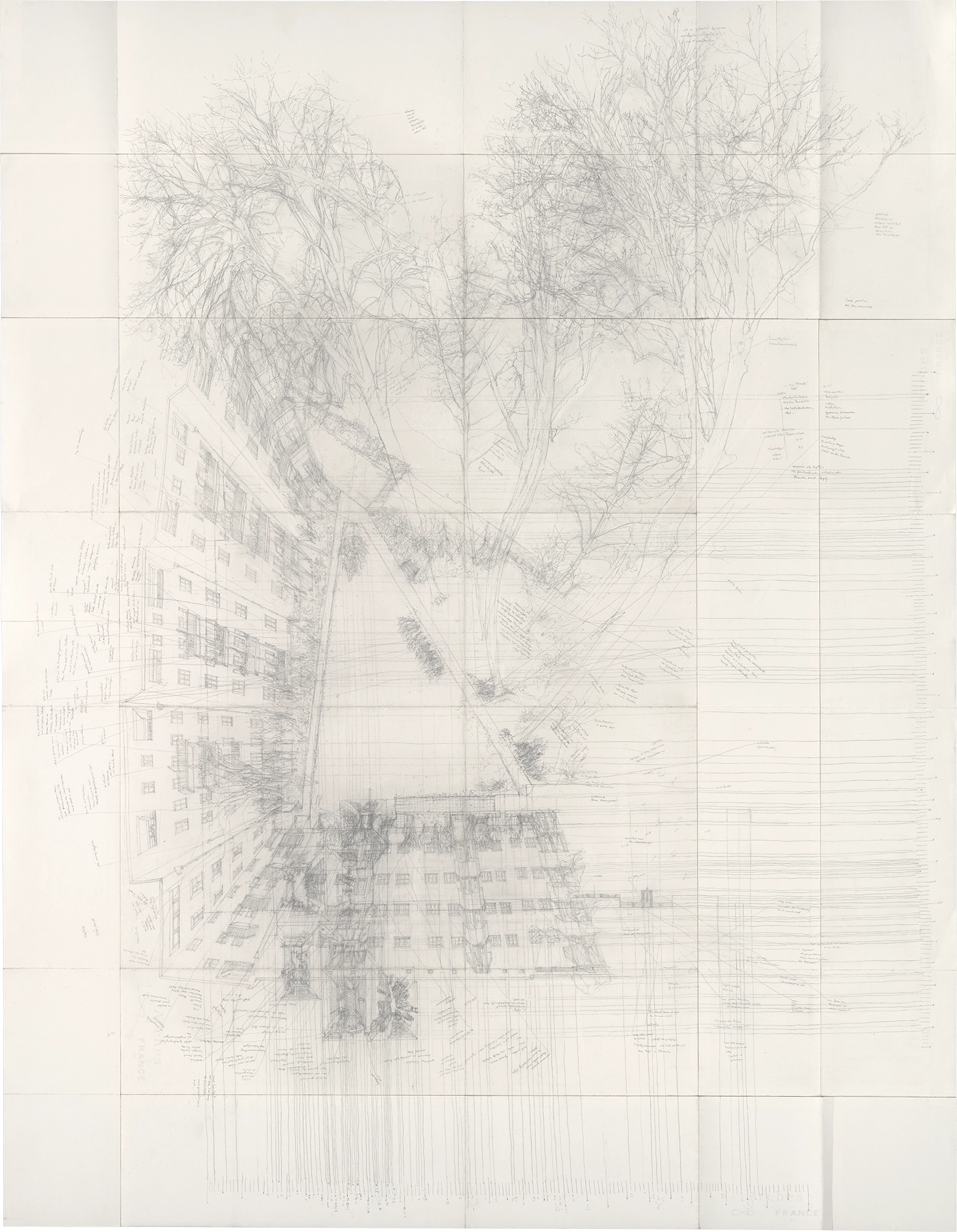
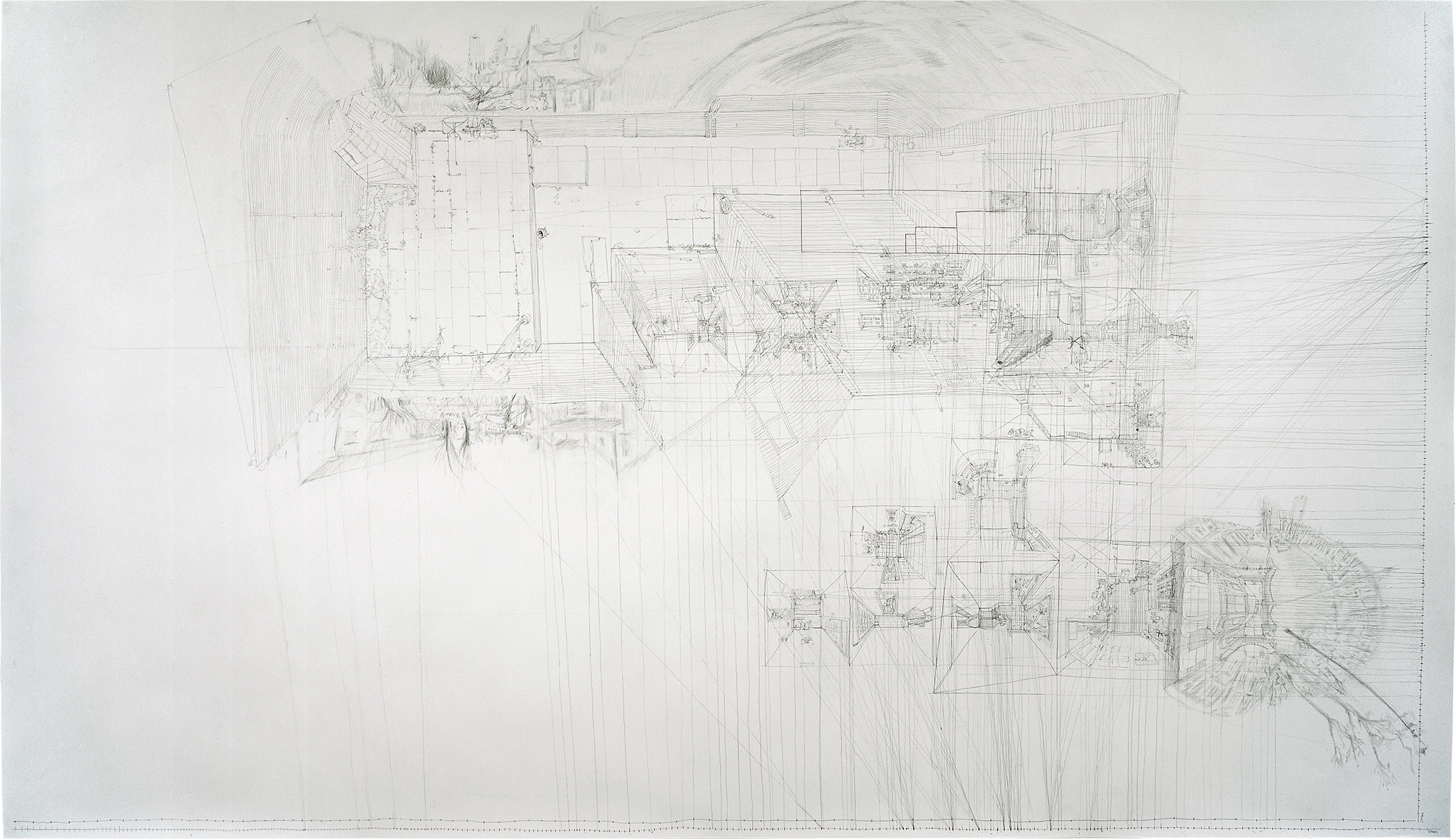
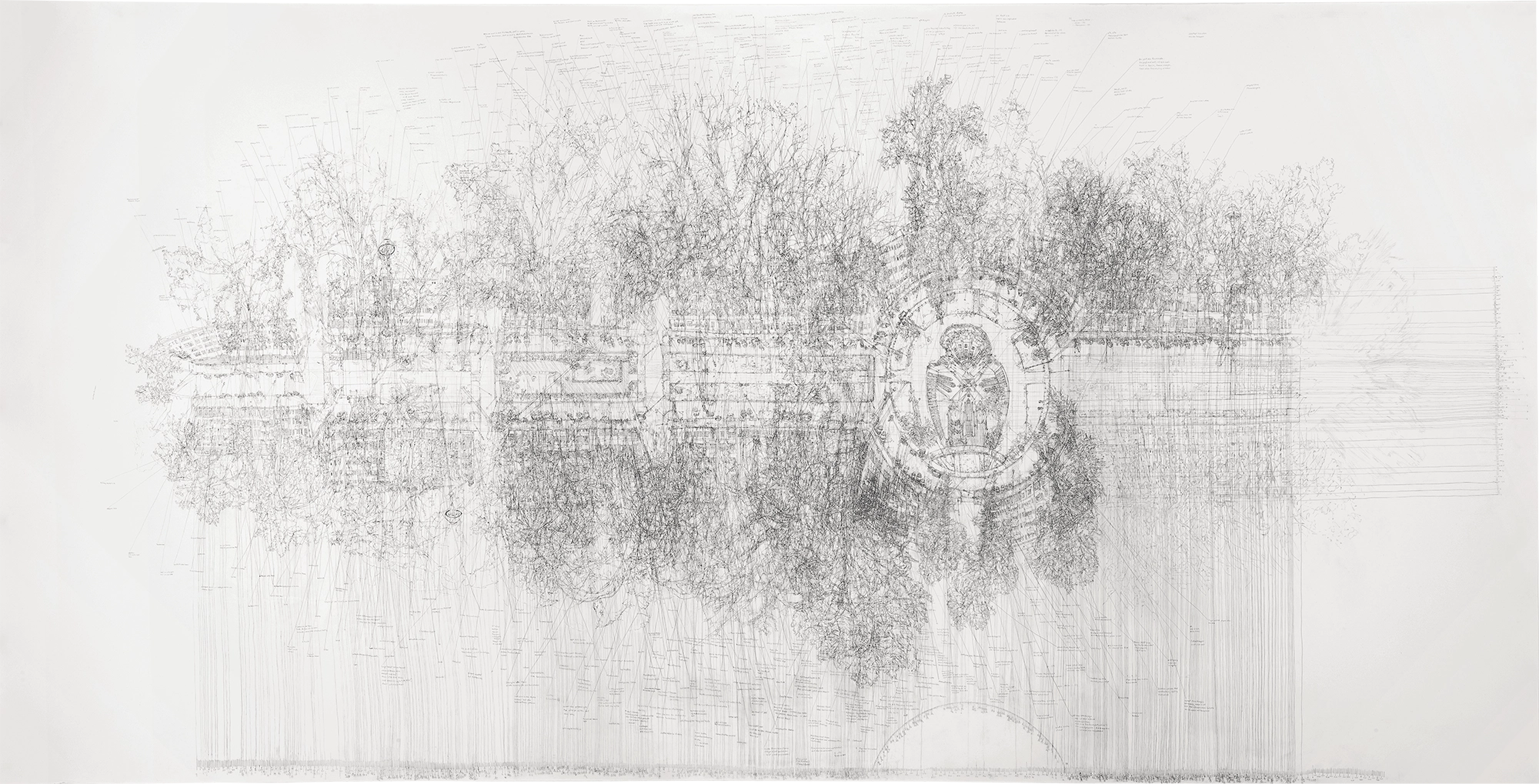
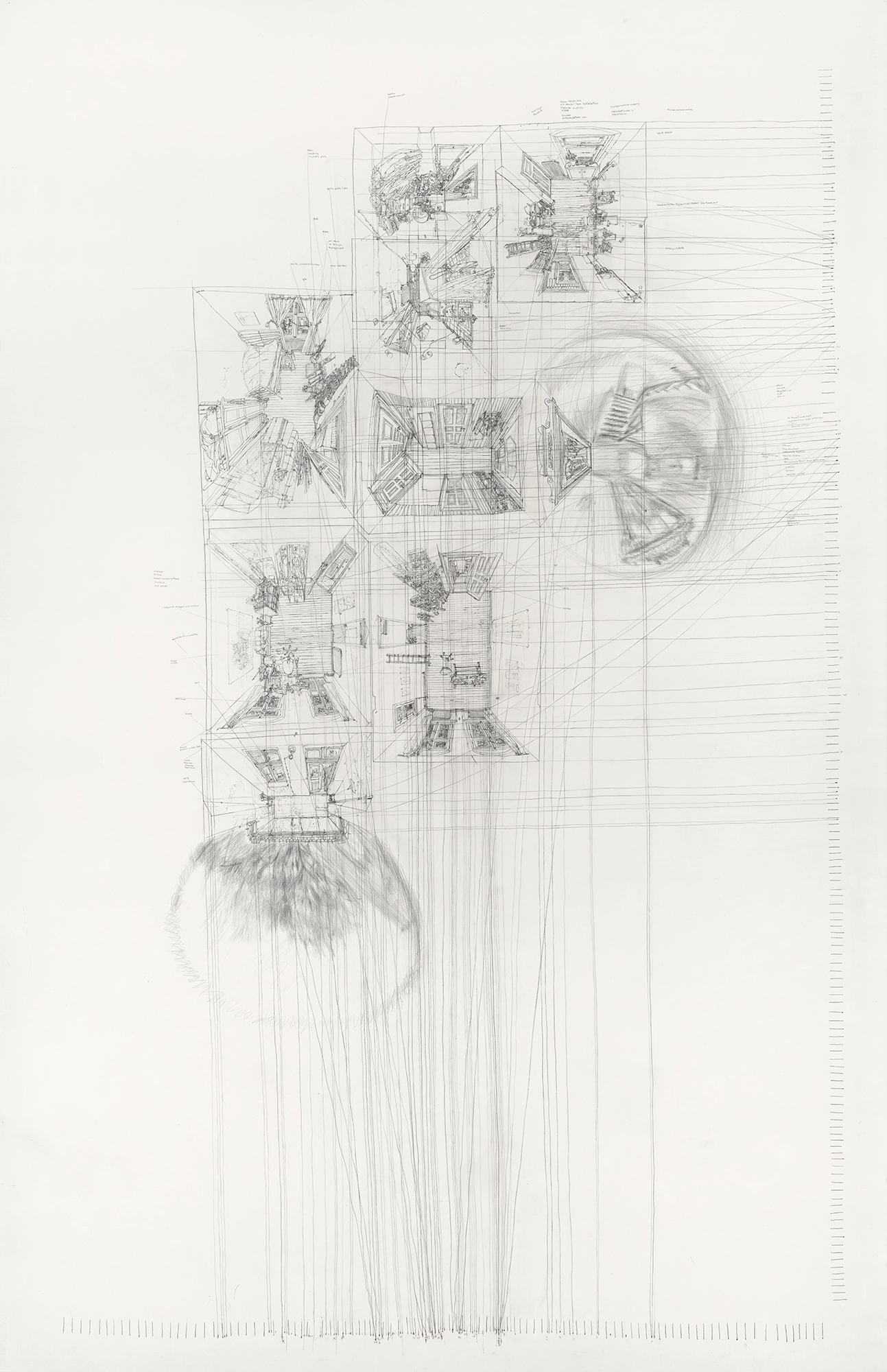
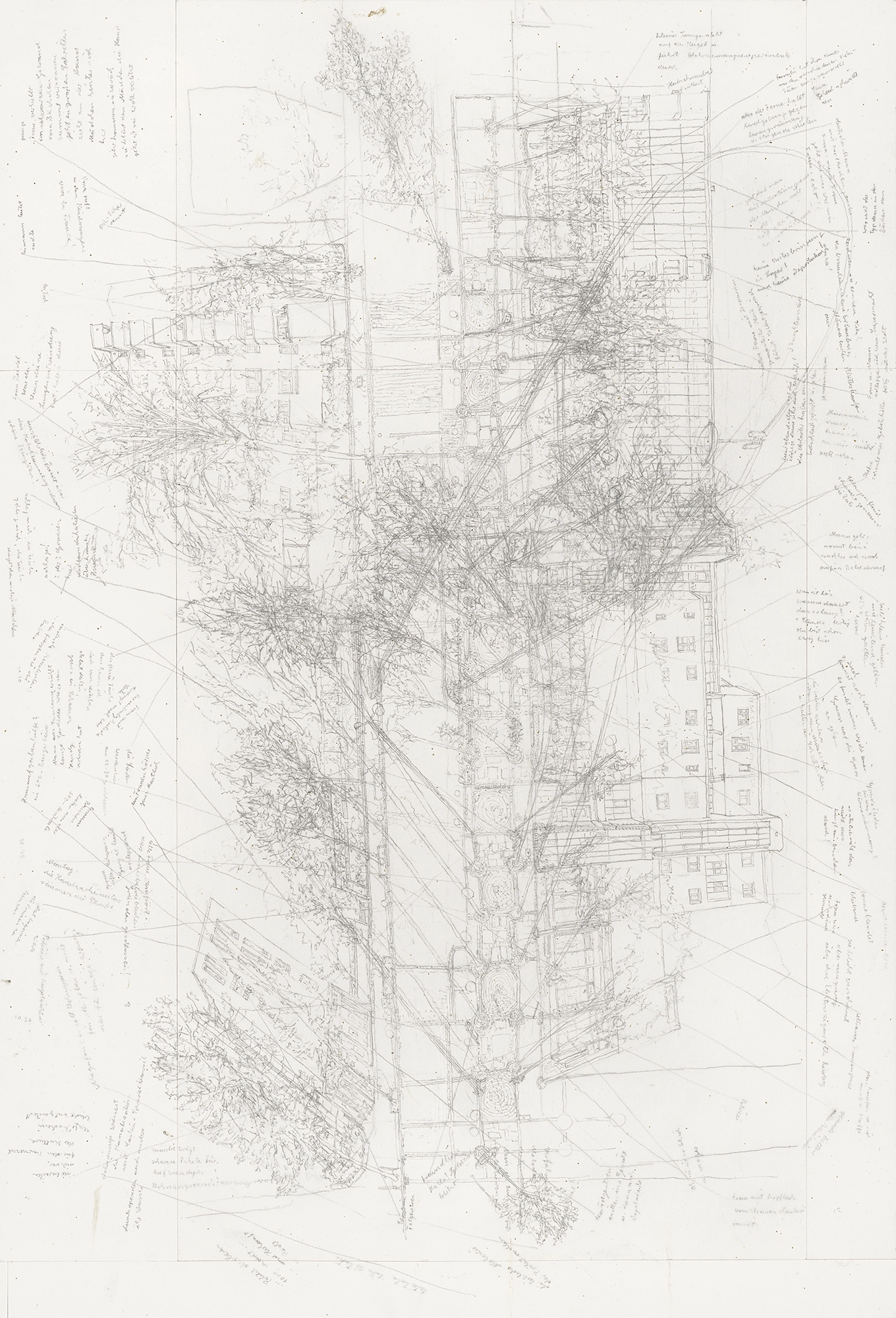
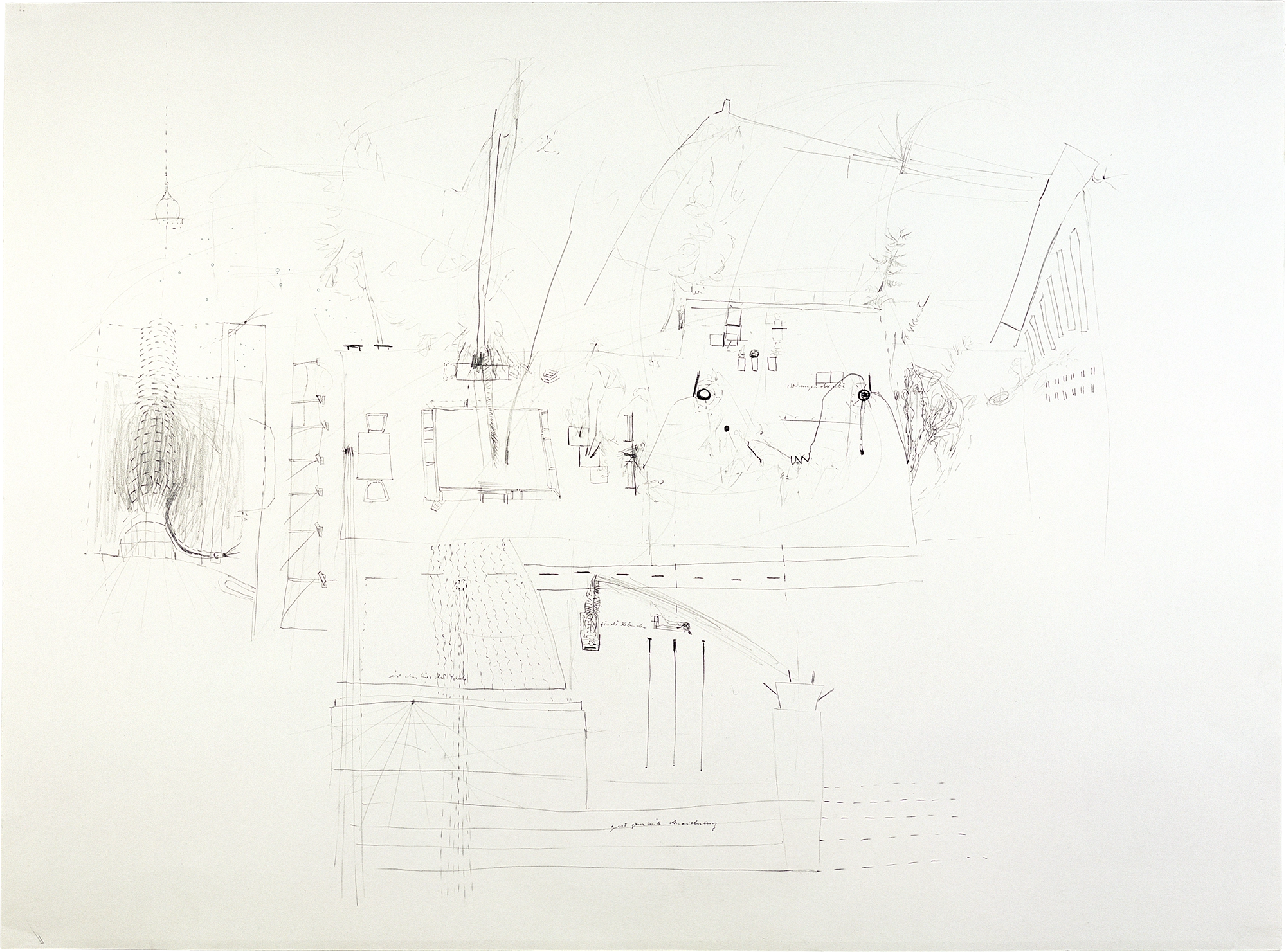
Parallel to the Box Engravings, I work on spontaneous, site-specific pencil and colored pencil drawings. + read more
I travel through Berlin by bike or on foot with my drawing board and intuitively decide where to stop, sit down, and draw. I am interested not only in what I see in front of me, but also in what I hear, smell, remember, know, and suspect during my stay.
In an almost dreamlike working process, it finds expression on the surface of the paper, which I initially regard, like the pictorial space of the Early Site Specific Pictures, as an undefined and therefore boundless space of possibilities in which the universe could easily fit.
− read less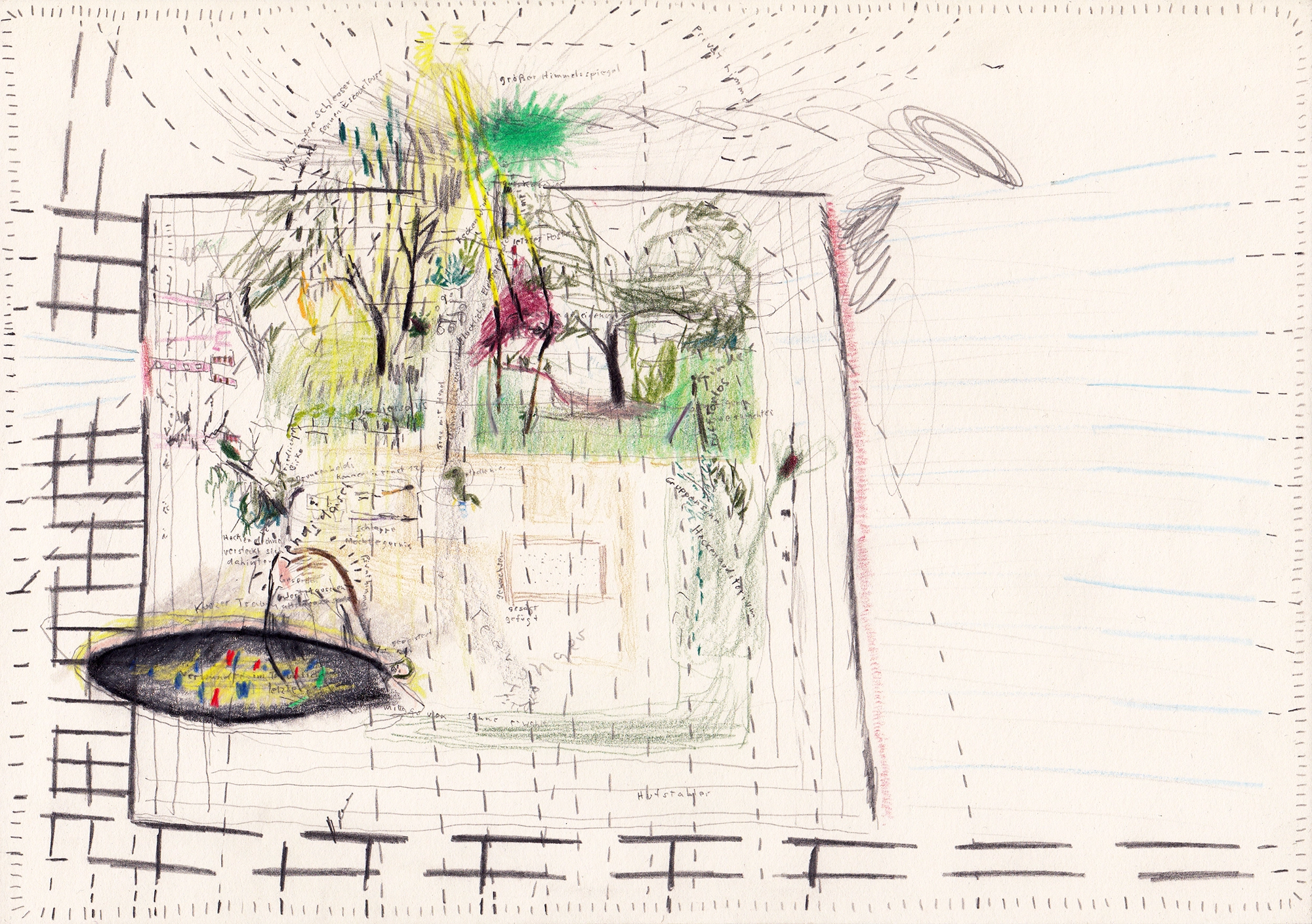
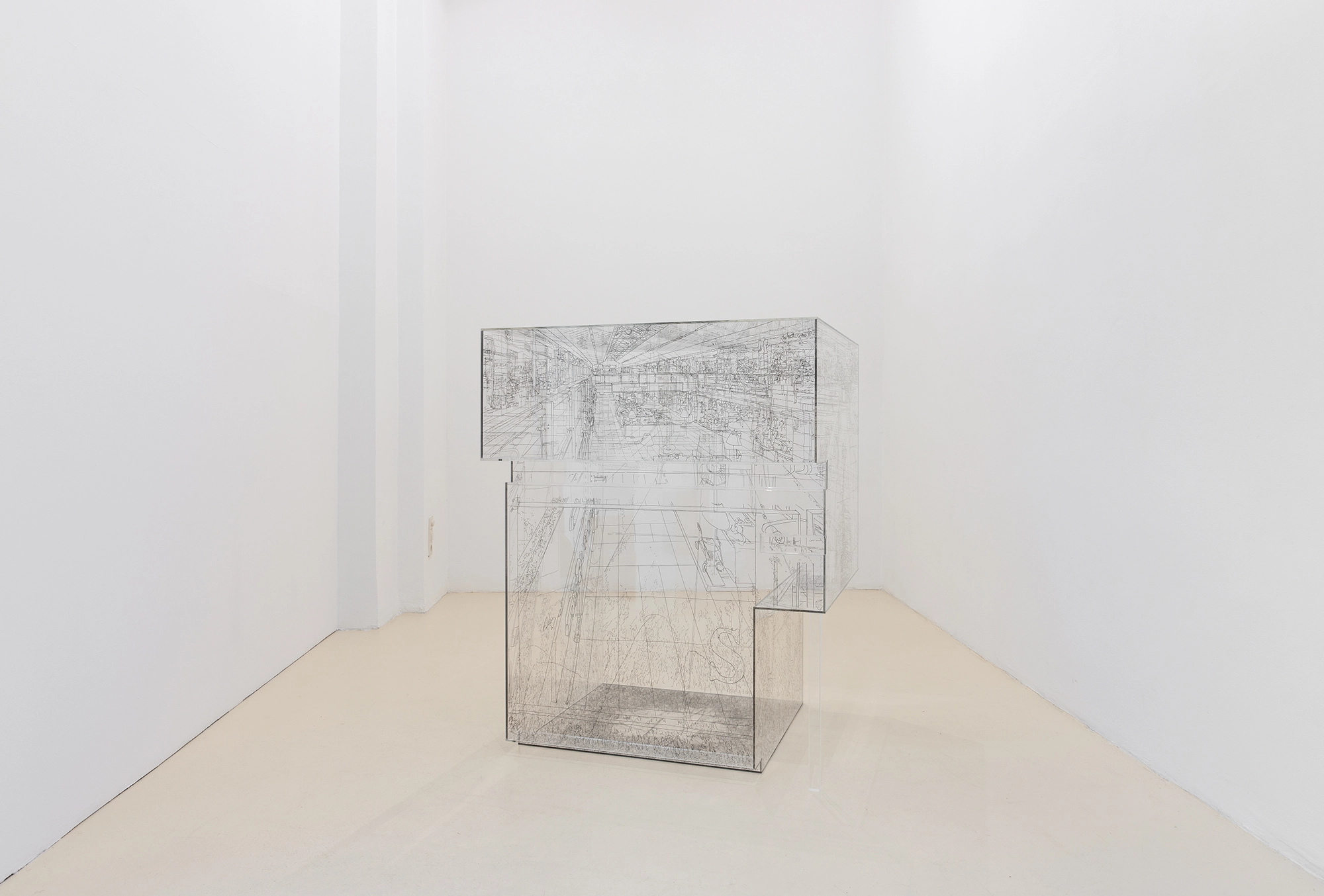
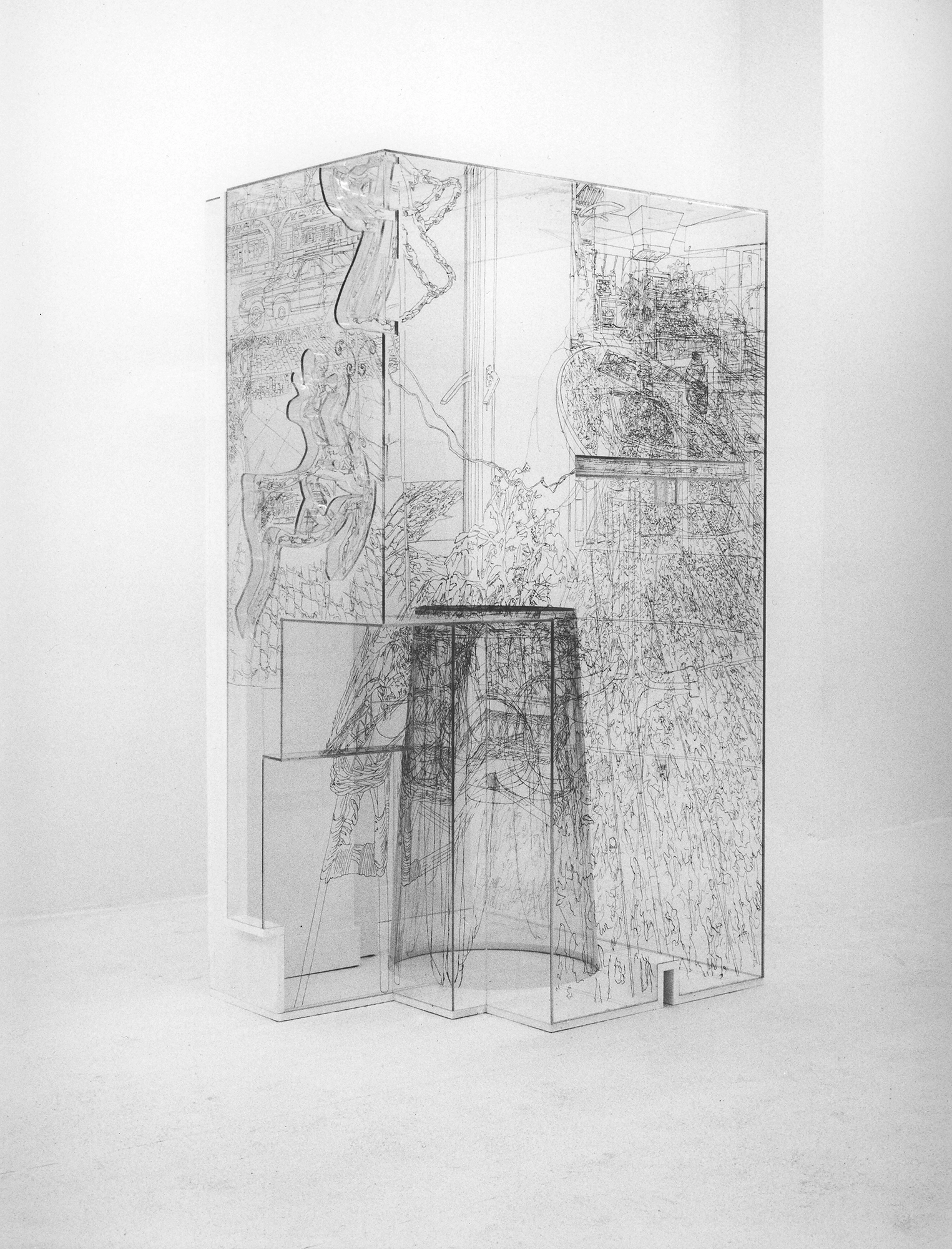
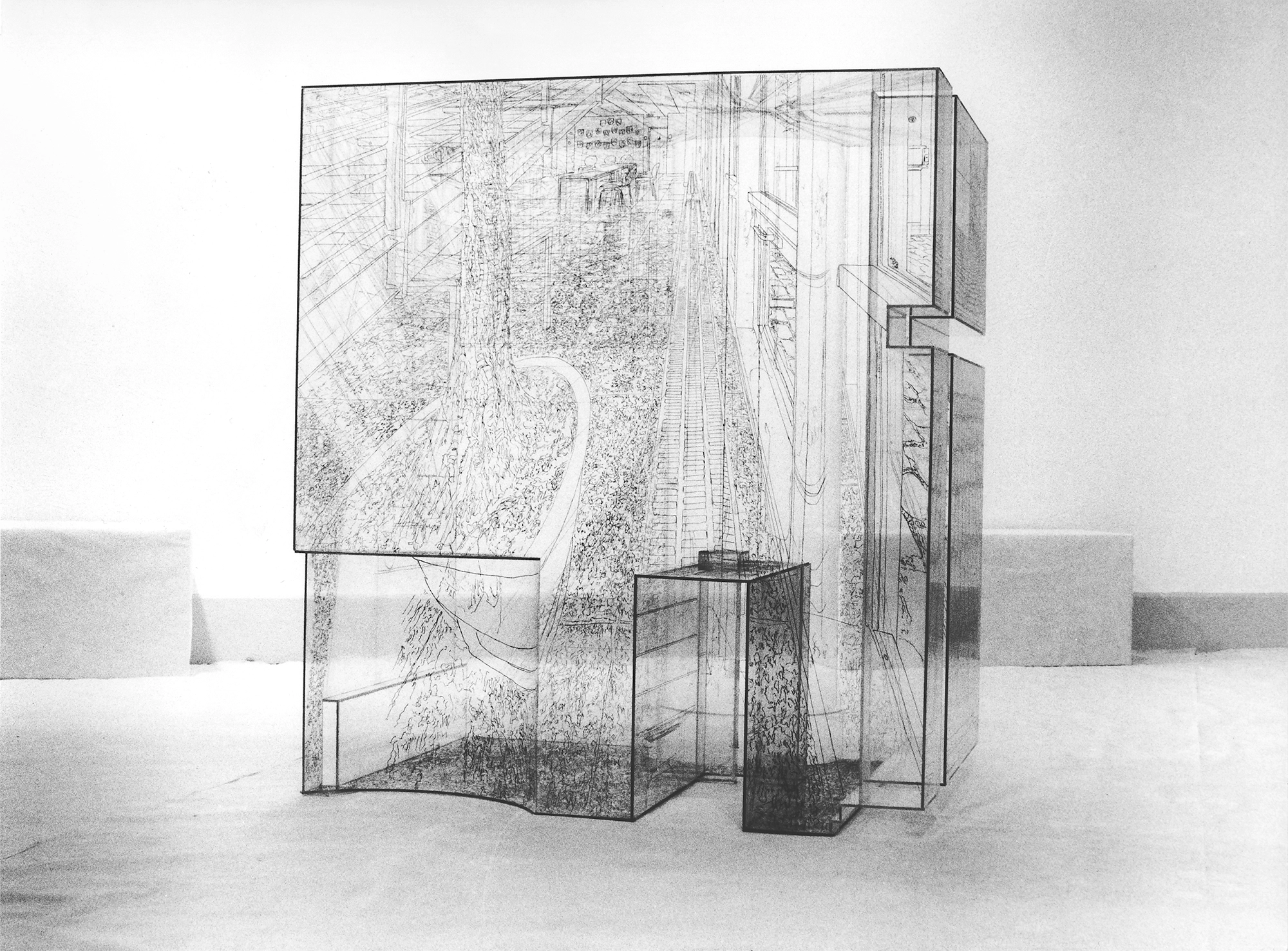
The three-dimensional Box Engravings belong to the body of work, Projection Works, and are a further development of the three-dimensional Cube Pictures. + read more
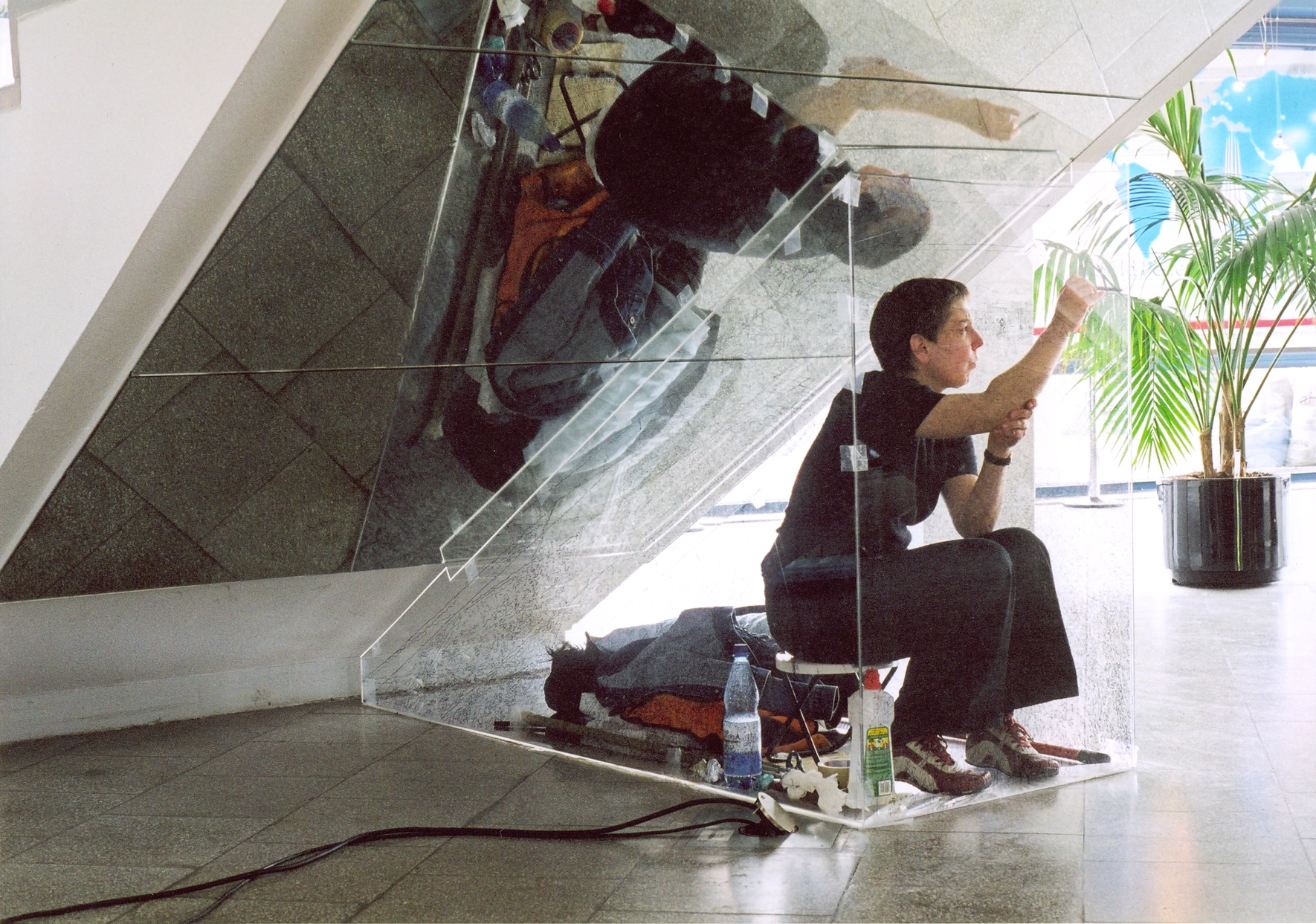
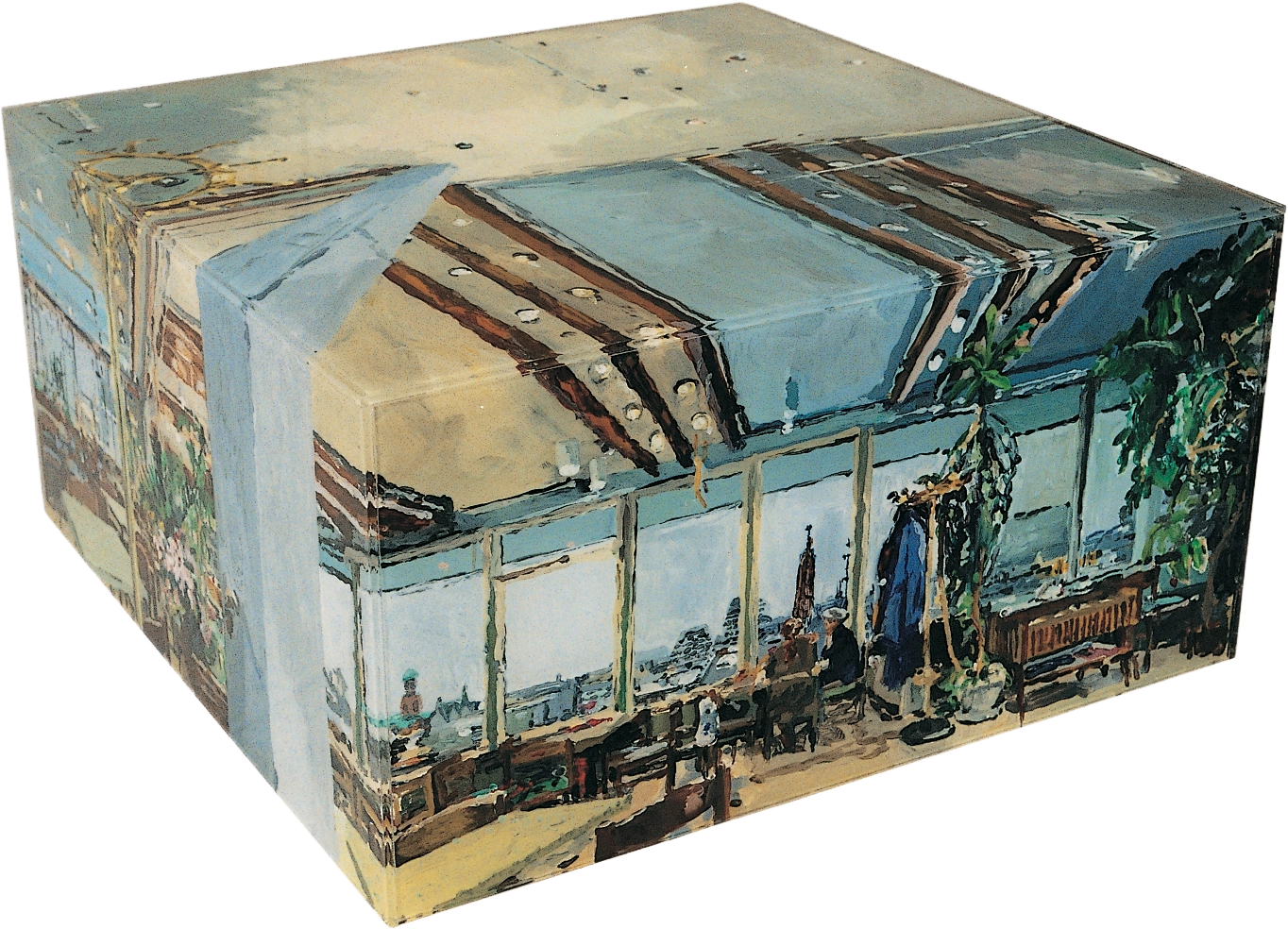
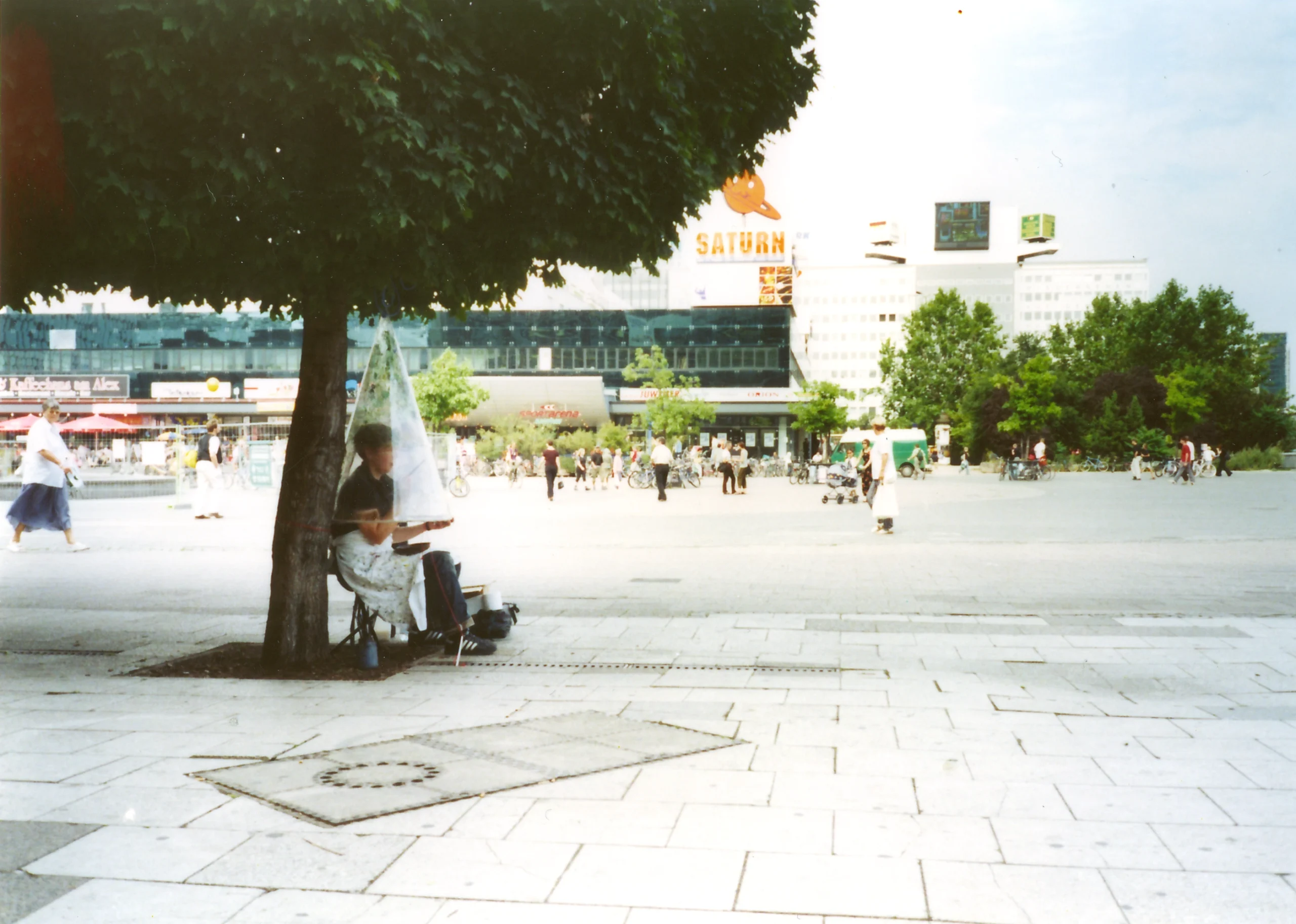
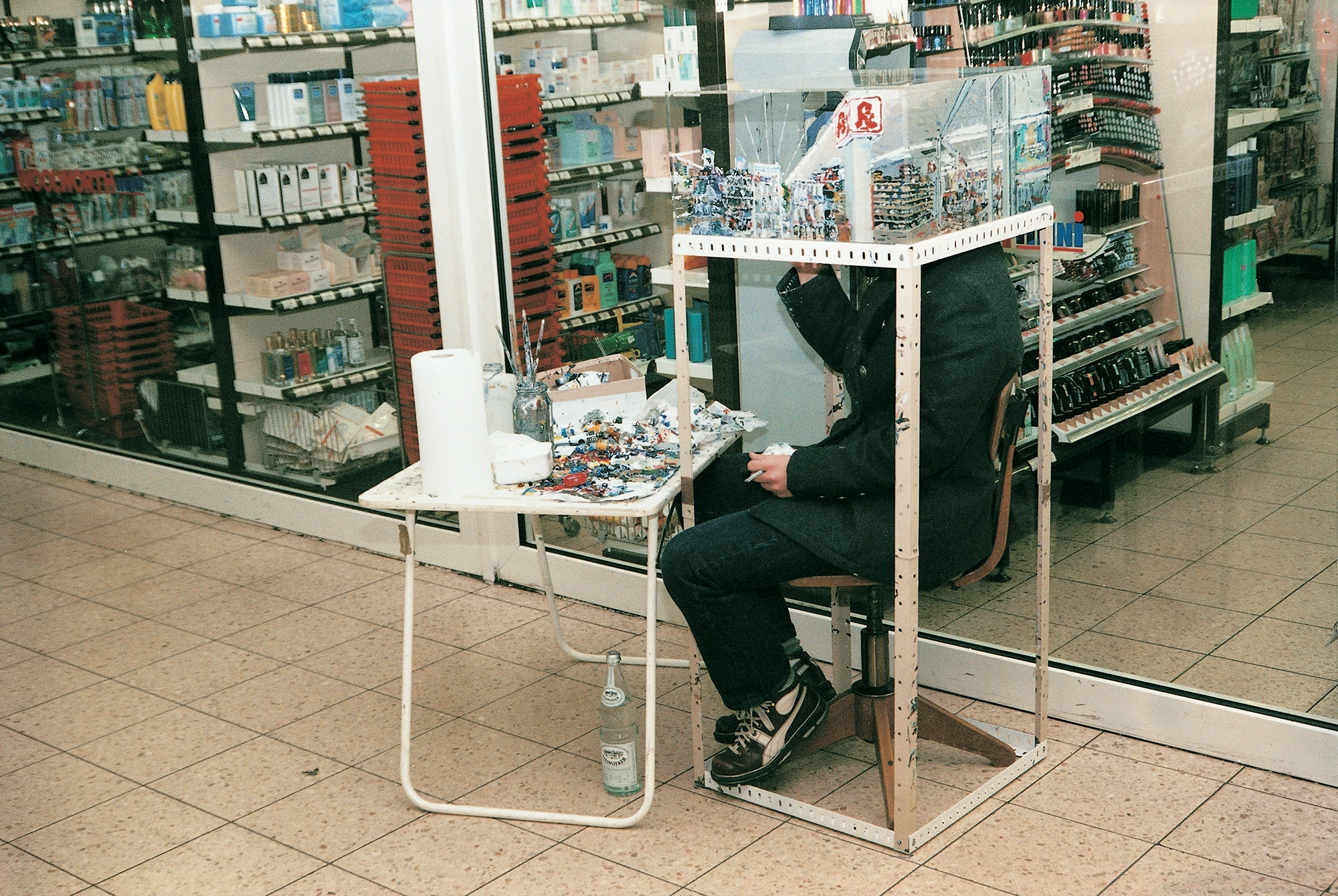
First, I build an acrylic glass construction in an architectonic or landscape location. At the chosen site I sit inside the construction and capture directly what I see around myself with marker in detailed drawing on the transparent inner walls. At the end I engrave the drawing into the acrylic glass. In contrast to the panoramas of the 19th century, in which the observer places himself inside the panorama, here the locked out observer views the miniature world of the Box Engraving from the outside. In this pictorial reality, the distance, and thereby the rest of the world, is always contained within the object.
One of the fundamental difference to the earlier Cube Pictures is that the Box Engraving is a closed form, which has in its spatial extension a relation of 1:1 to its site of origin. From this tangible space the view takes off into the intangible.
− read less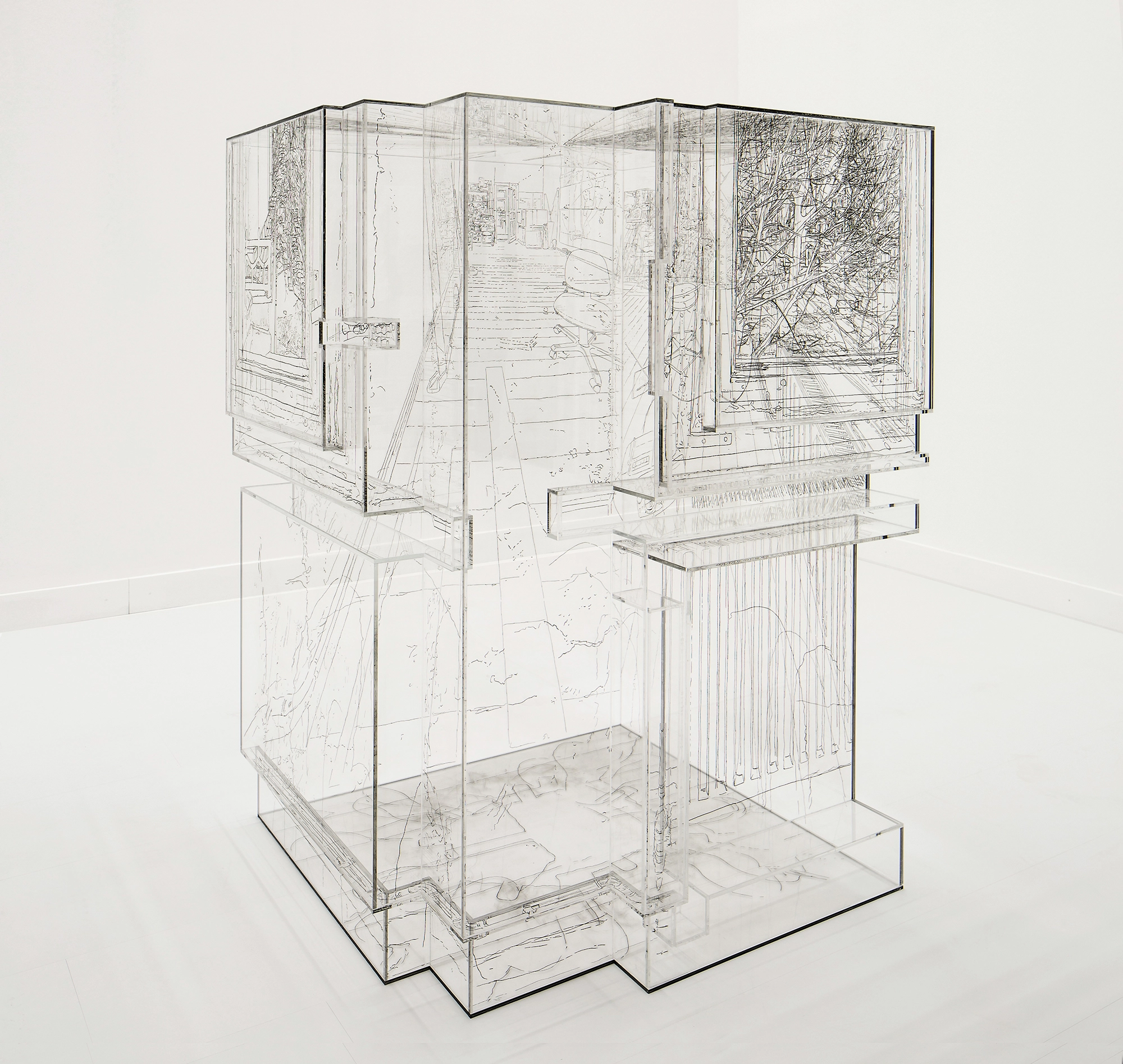
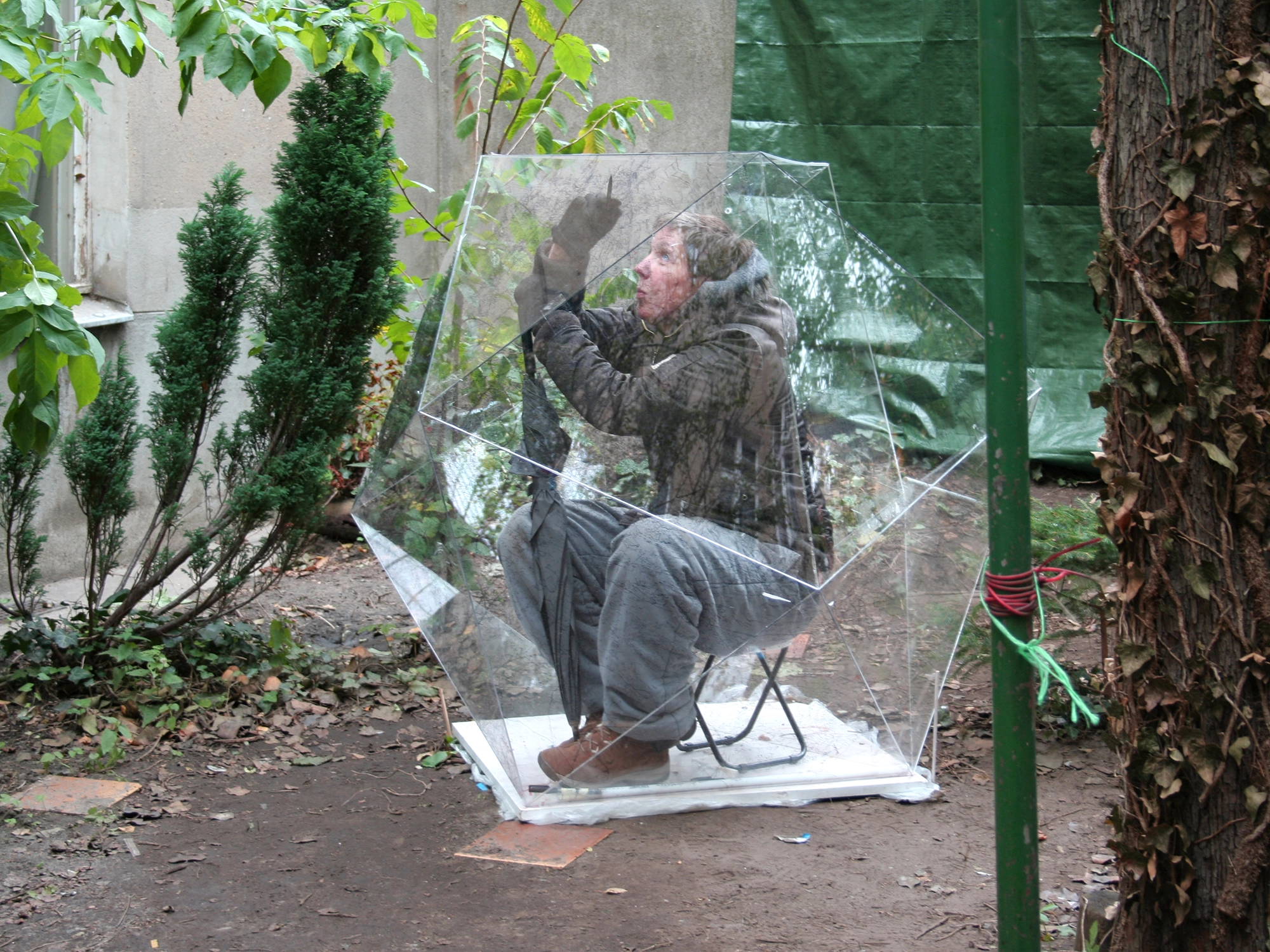
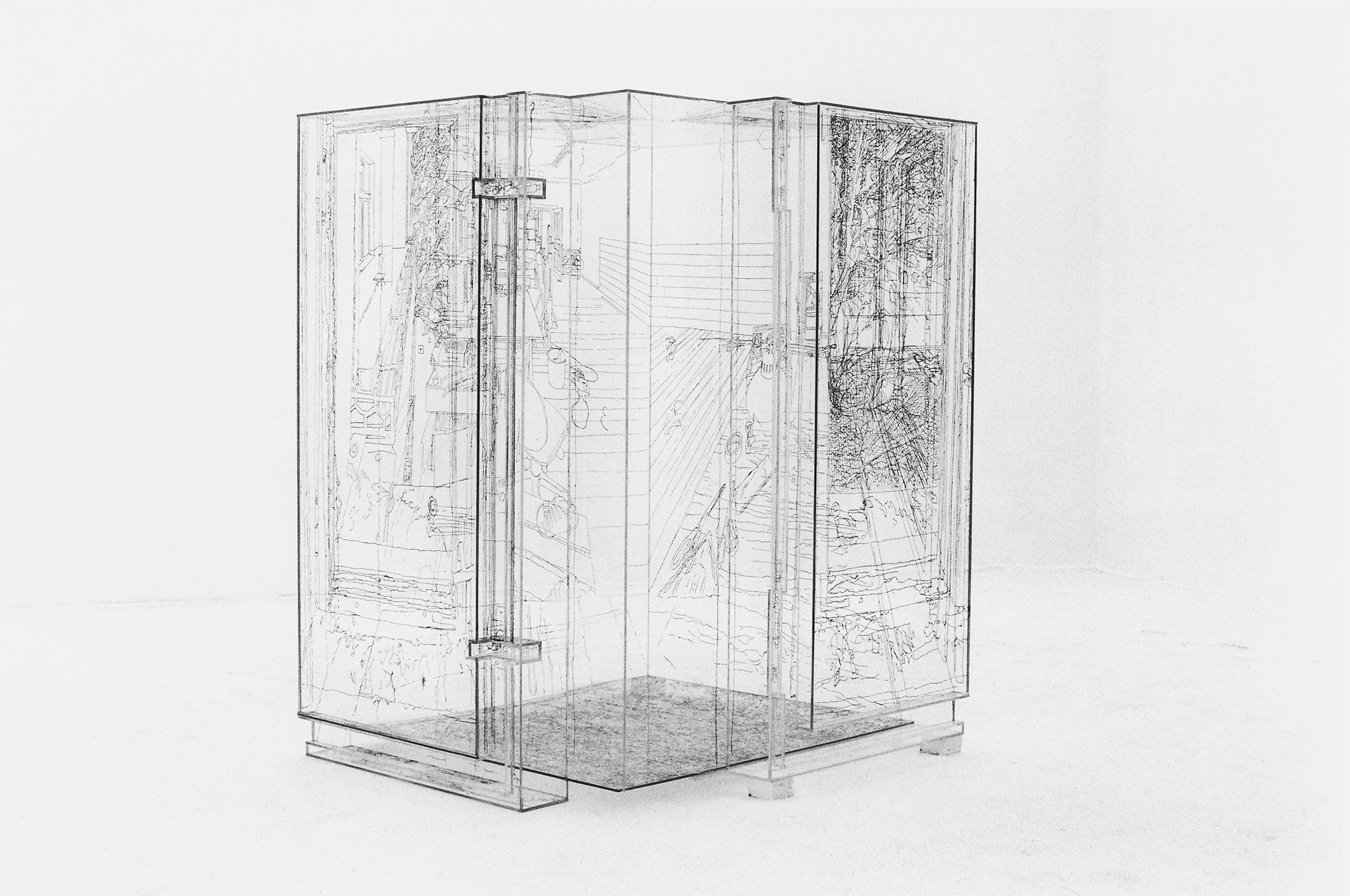
The Field-of-View Projections belong to the body of work, Projection Works. While, with the Cube Pictures I capture the world around myself in its entirety, here I am interested in capturing the whole Field-of-View itself.
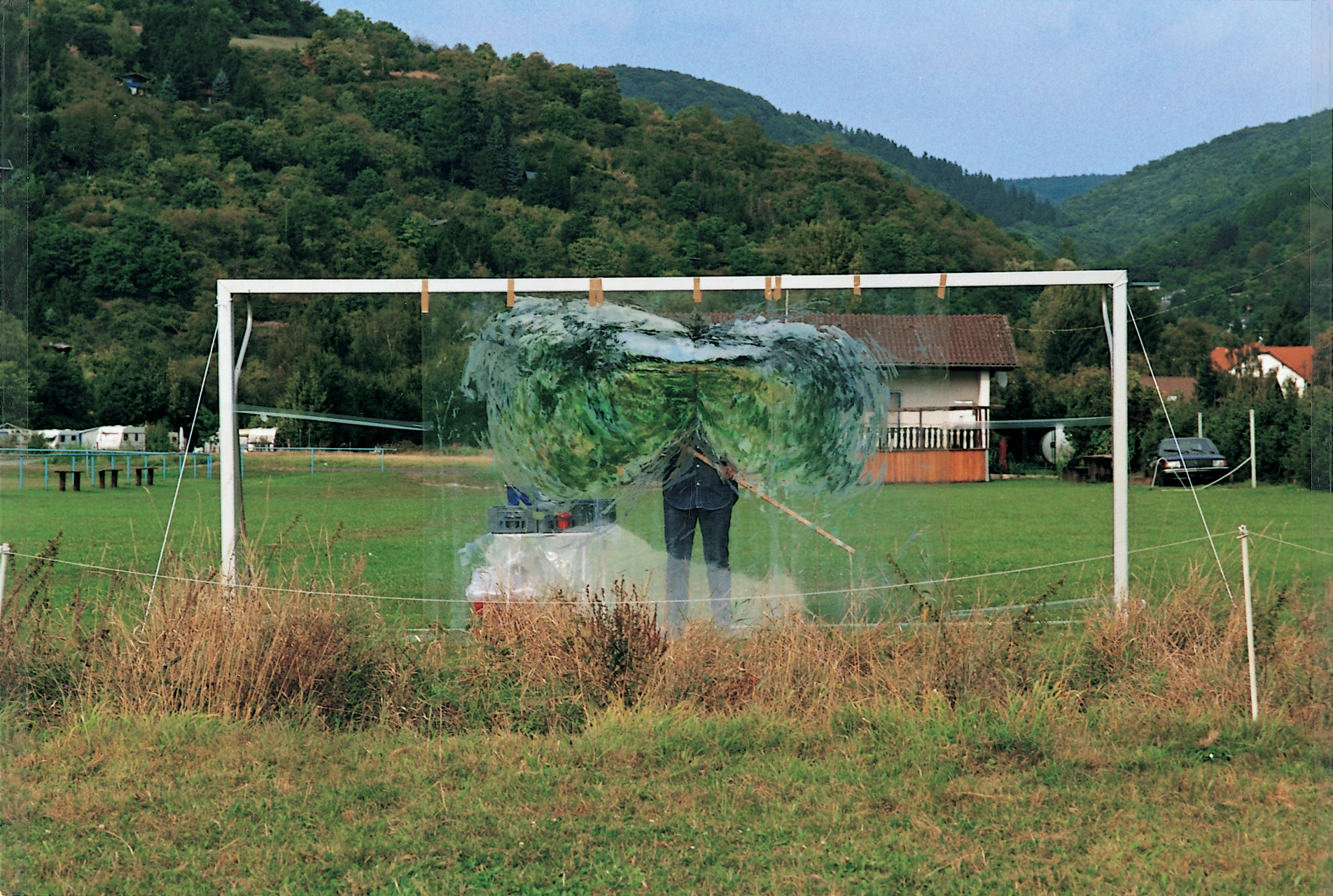
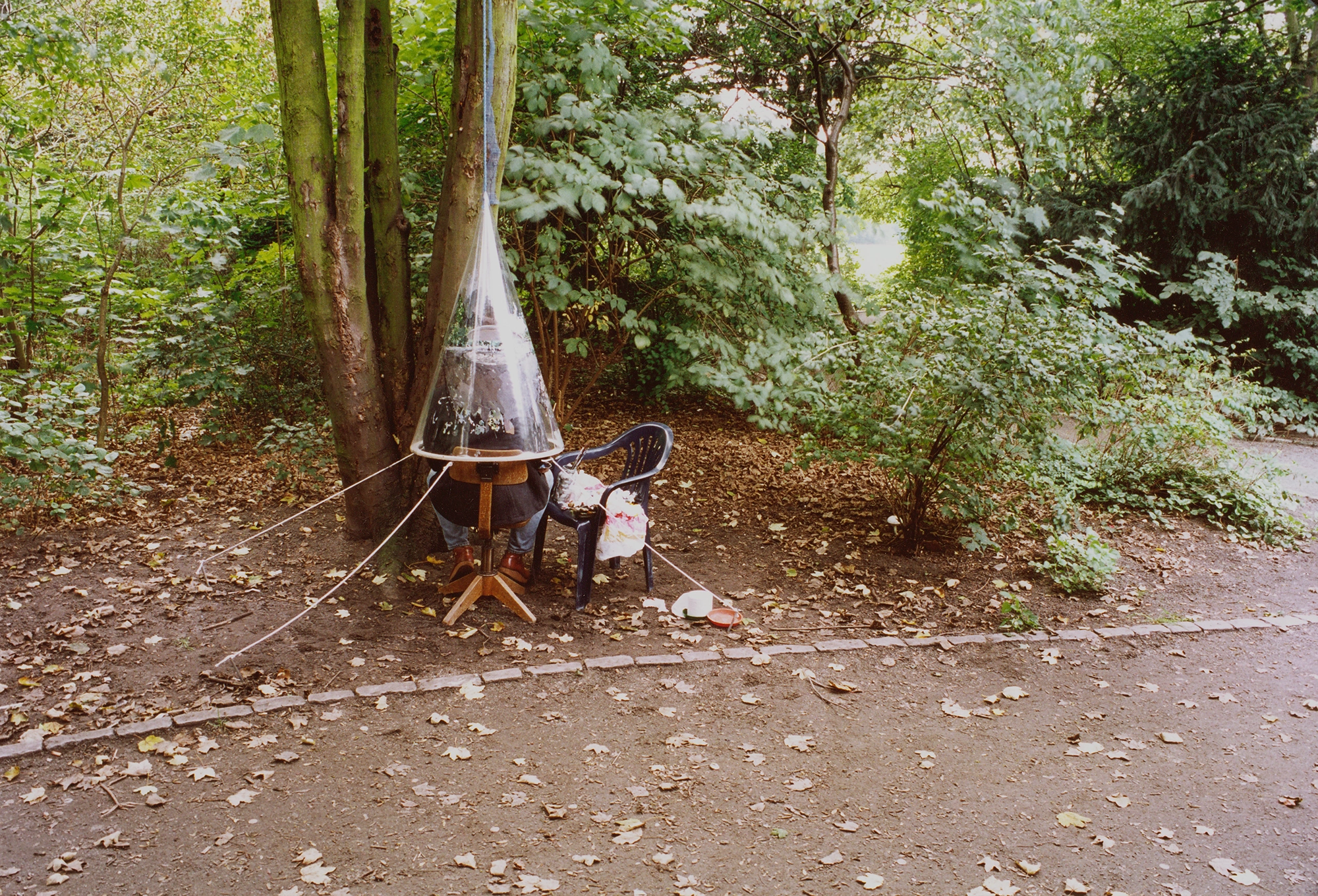
I place myself under a transparent acrylic glass construction, which through the use of a stand stays fixed to the height of my view. + read more
From inside, I look out at my environment and fix directly what I see around myself with paint and brush on the inside of the cube. Differently than the earlier window pictures, here I pay attention to the preservation of the conventional perception of space. During the work in process, which can take many weeks, I fully complete a 360° turn on my own axis. From outside observation, I disappear more and more behind a painted, turned inside out inner view.
It is an attempt to objectify my subjective perception. In contrast to the panorama, in which the viewer places himself within the image, thereby maintaining his subjective point of view, the Cube Picture, with its closed objectivity, turns away from the viewer and thus creates a critical distance.
The distance, in other words, the rest of the world, is located within the pictorial reality of the object.
− read less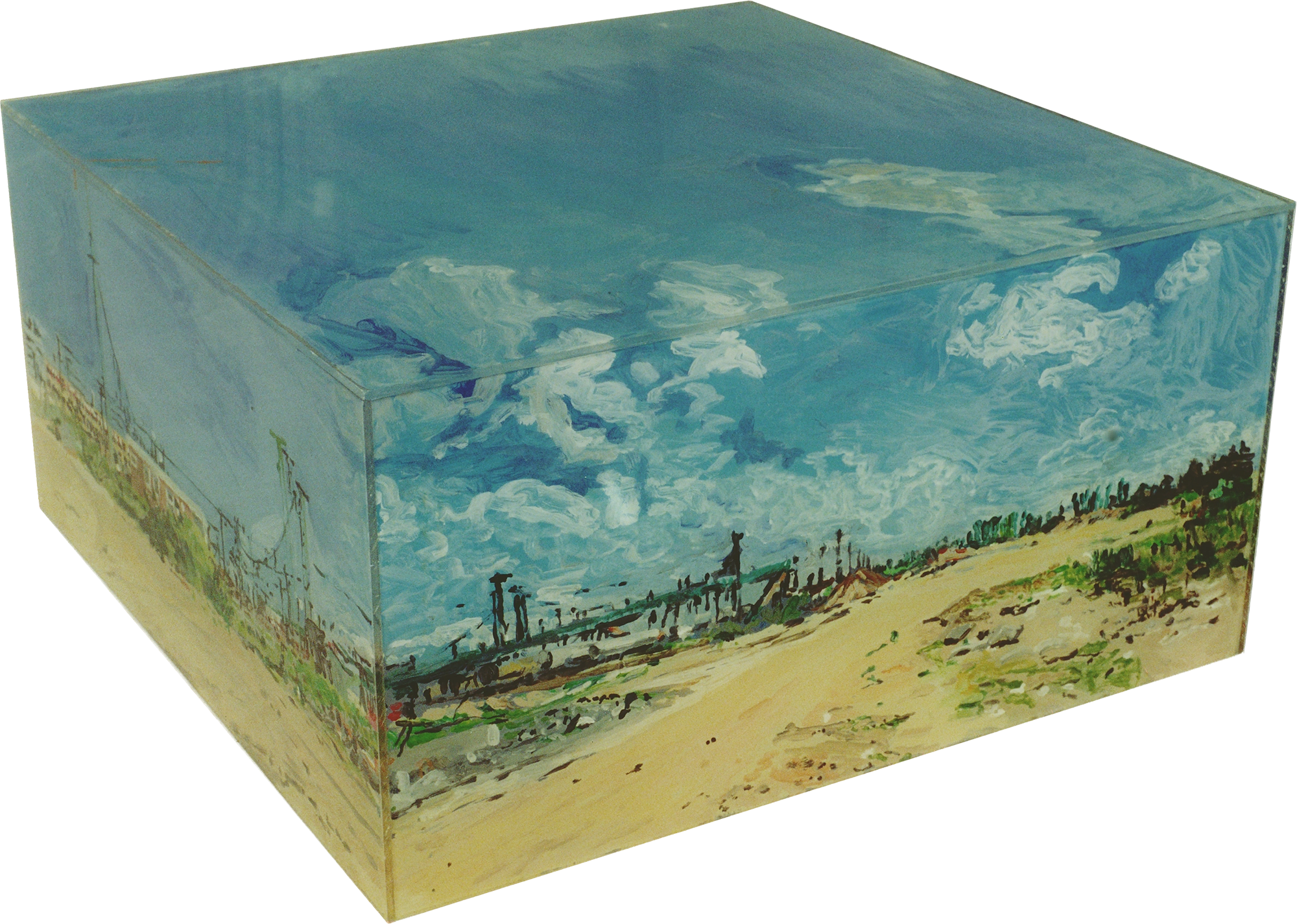
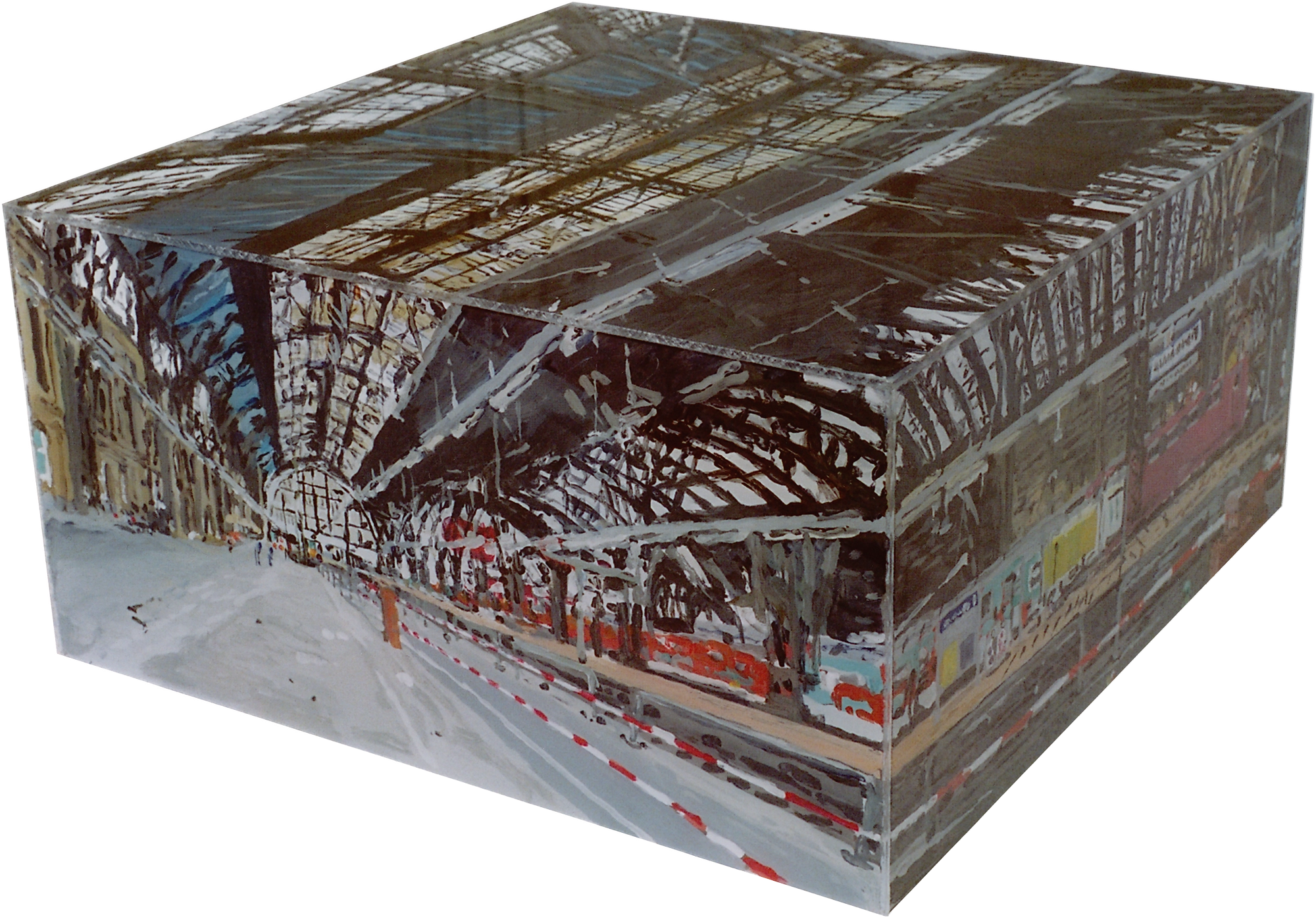
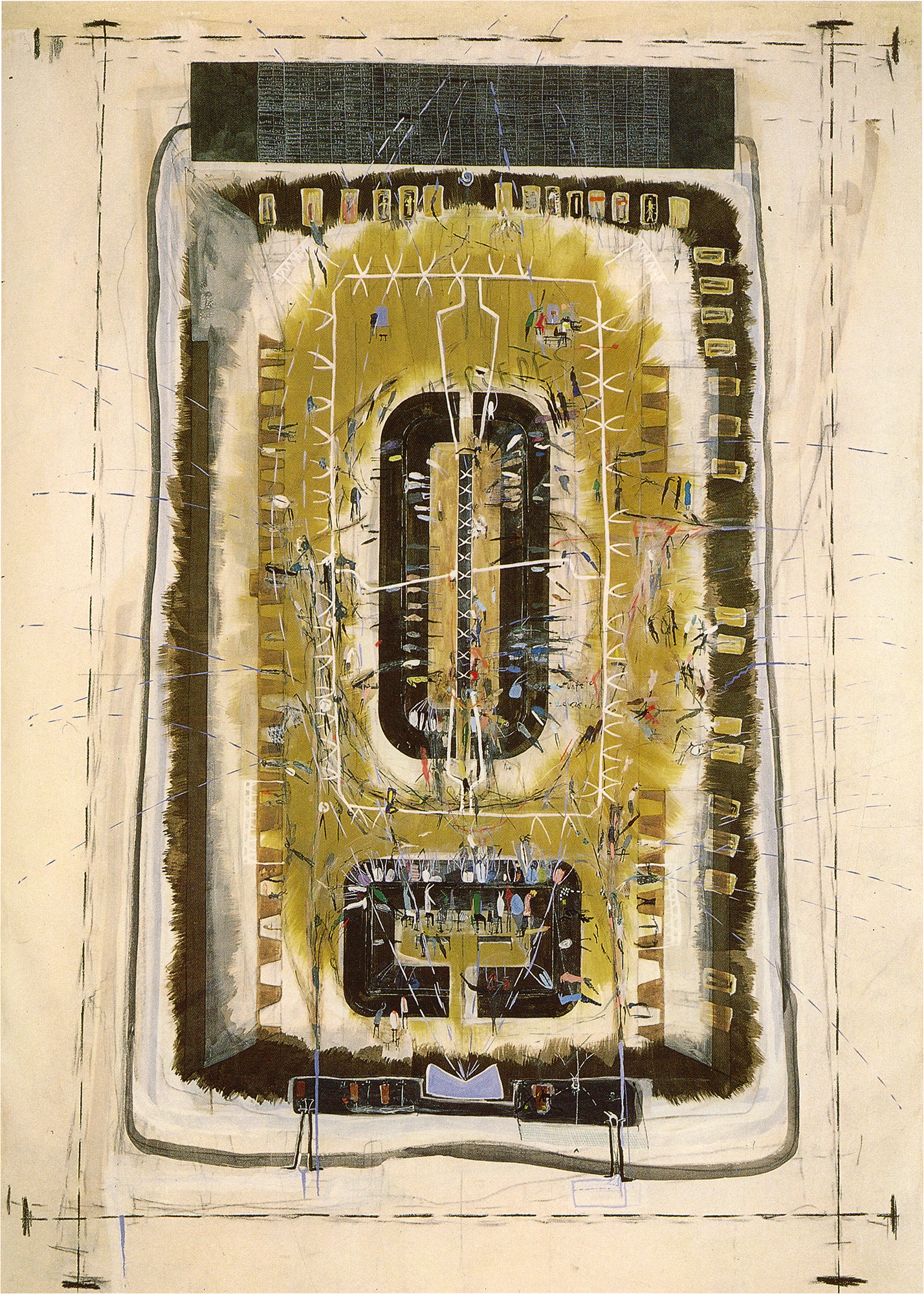
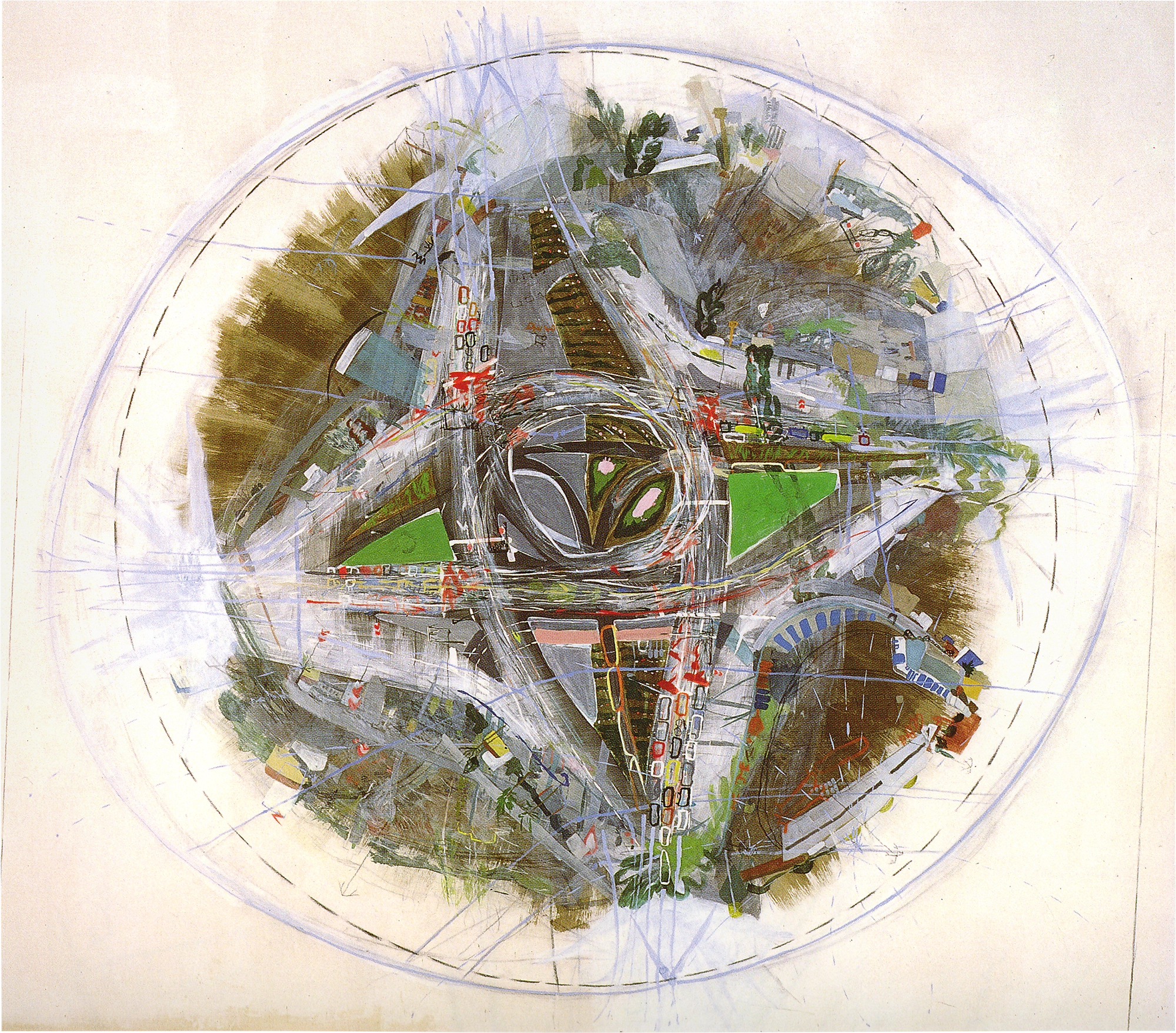
By attempting to transfer the experienced reality of time and space into a two-dimensional static picture reality, I discovered with the Early Site-Specific Pictures during my art studies in the 1980’s, questions and possibilities, which still occupy me today. I therefore see the Early Site-Specific Pictures as a foundation and key to my artistic development.
+ read more
My experiences and memories from many perspectives within a place, and the knowledge that the place does not depend on my subjective perception but exists constantly and simultaneously for itself, are decisive for my search for an adequate pictorial order and also for the positioning of the viewer in relation to my pictorial statement of the place.
Finally, the Early Site-Specific Pictures are close to a map-making way of seeing. At a specific location, for example the Frankfurt Train Station, I collect information, which is often penetrated from subjective experience and poetic notions. I synchronize these into a kind of map, reinterpreting the notes for the specific medium of the picture.
In doing so, I discover the two-dimensional surface as an unlimited space of possibilities, which gives me the opportunity to accommodate the undefined rest of the world between the focused location and the edge of the picture.
− read less